
Part 2: Backs Against the Wall

More questions and assumptions. Didn’t your mother ever tell you what happens when you assume?

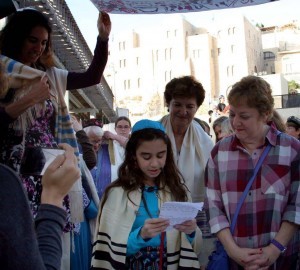
Yesterday I posted this picture on Women of the Wall’s facebook:

Bubbi

This is my actually Bubbi and she called me the night before Rosh Hodesh to wish me luck, tell me how proud she is of me. She asked my mom to take a picture of her, proud in her tallit. She told me to share and to tell everyone that they should let us pray in peace. I did that for her.

There were supportive comments but there were also accusations of “manipulation”, “cheap” and other insults. The constant assumption that we spend our time creating stunts and the constant questioning of our genuine religious and spiritual intention is just offensive. Who are any of us to judge others’ commitment to Judaism on any basis? Why don’t we all just focus on our own connection to God? To me it shows an insecurity on the side of those who make the assumptions and question the intentions of others, their own self-doubt in their belief system.

Here are some more (more) misconceptions and assumptions about Women of the Wall that need to be set straight.  These are direct quotes but as the questions come from non-public interactions, I leave them anonymous.

1. “How does praying in a traditional male fashion constitute a “right”?”

So many assumptions, so little time.

First, every women who prays with us prays differently, what bonds us is that we believe that each woman should be allowed to pray according to her belief, free of judgment, without harassment.

Second, a tallit is not a “fashion” or a “prop” as you like to call it. That is disrespectful. Surely you don’t call a man’s tallit a prop or fashion choice. Tallit and tefillin are Jewish articles that men are obligated to wear during certain prayers and though women are not obligated to this, they are also NOT forbidden by Jewish law. Women who take this on take it on as a commitment as they do other Jewish laws- for example lighting shabbat candles, praying three times a day, or kashrut. Who are you to tell them not to do what is permissible according to Jewish law?

Lastly, you have confused an issue here, so let’s clear it up. The rights we speak of, which are refused to women only at the Kotel, are freedom of expression and freedom of religion in the public sphere. In my last clarification I explained that the Kotel is public space and that the Israeli Declaration of Independence guarantees these basic rights, free of discrimination based on gender (male/female). Please go back and read this. Therefor, a woman whose religious tradition for the past 50 years has been to wear tallit when she prays, has a right to her freedom of religion at the Kotel.

2. “If a mode of conduct at the Kotel greatly offends the vast majority of people who daven there regularly, isn’t it bigoted (AND intolerant) to say “that’s their problem”?”

We have never said “that’s their problem” so I would appreciate that you not put words into our mouths. Again, I refer you to my previous article where I write about lashon hara (Hebrew: the evil tongue), the halakhic (Jewish law) term for derogatory speech about another person.

Also, haredim are not the vast majority. They make up 8% of the population in Israel and if they are the majority of those who currently pray at the Kotel, I suggest that this is because of the haredi control over the space. In the past years, Rabbi Rabinowitz’ reign over the Kotel has caused the Israeli army to cease holding most of their induction ceremonies there due to discrimination of female soldiers, new immigrants, olim, and tourists have ceased to come to the Kotel when they first arrive in Israel because they fear and resent the judgement and limitation their feel there. Secular Israelis have for years and years been saying that they don’t feel comfortable at the Kotel, I hear this from friends and family all the time. They do not like the Kotel and they do not want to go there because they feel unwanted and unwelcome there. This is exactly what is yelled at us on am monthly basis: “You are goyim (derogative for non-Jews)”, “This place is not yours, you do not belong here.” This does not make the majority an accurate majority but a forceful, exclusionary majority.

Most importantly: just because a group is a minority does not mean they do not deserve full rights (see my definition of bigot, below).

In addition to these important facts, I definitely do not think Women of the Wall is bigoted and intolerant. A bigot is “someone who, as a result of their prejudices, treats other people with hatred, contempt, and intolerance on the basis of a person’s ethnicity, religion, national origin, gender, sexual orientation, disability, socioeconomic status, or other characteristics” (wikipedia definition). We are not doing anything to anyone. In fact what we do (through prayer) is for ourselves and our daughters but we are also ensuring all women’s rights to pray at the Kotel in the future. The women’s side has shrunk from half to 1/5 of the space in front of the Wall. What’s stopping them from banning women all-together, or exiling all women to Robinson’s Arch? We are ensuring that this will not happen. Our prayer does not infringe upon anyone else’s rights or actions. For 24 years other Jews have continued to pray and gather during our prayers. There is always more than enough space in the women’s section for all of us and we welcome you, with and because of the differences between us.

So I do not want to state the obvious, but you brought in the word bigot and I looked up the definition to be sure, but it seems like it is you who are prejudiced against us, treating us with intolerance on the basis of our religion and gender.  We welcome you to the Kotel, we welcome your prayer, your sisters and daughters and their prayers. It is you who wish to stop our prayer because the differences between us trigger your prejudices and hatred.

3. “I’m pretty sure the women for the wall started their crusade only after the whole PR campaign launched by Women Of the Wall with the obvious agenda to change the status quo NOT just at the kotel (no I have not been fed lines- I have read your posts and media responses)”.

We have no agenda past the Kotel. Women FOR the Wall often quote Anat Hoffman when she is speaking from her professional, full-time position as the Director of the Israel Religious Action Center. It is confusing, I can agree with that, but then why have they never asked us about this? They run straight to the media with their assumptions. We cannot and would not silence our most active volunteer. Anat is in the media often and when she answers she often speaks with her IRAC “hat on”, as is understandable. IRAC is an independent organization that supports WOW’s agenda but also works on many, many different fronts in Israel. Women of the Wall works on only one front: the Kotel. You are welcome to look at our website to confirm this: www.womenofthewall.org.il.  So this is a misunderstanding as to our goals. Thank you for allowing us to clarify.

4. “If your mode of prayer was in fact in line with traditonal Jewish teachings (and not egalitarian feminism) no one would have any problem with davening right beside you. So why not take off the talit and teffilin (which only symbolize the adherence to Oral Law), stop your OWN crusade (and youtube clips that are glaringly anti haredi), daven with us in peace as you have done for 24 years-and in essence practice what you preach?”

There are a lot of assumptions and loaded words here. (I take a deep breath and dive in)

  • We are a pluralist women’ prayer group. Each woman defines her religious observance and commitment in her own way. I would never assume to be able to define your religious observance. Even if we met and prayed together, I would still allow you to define yourself in your own words. I ask that you extend us the same courtesy. Let each woman define herself and do not generalize about us. We are a feminist organization. It means we believe in the advancement of women’s rights and women’s empowerment. Nothing to be ashamed of. Some of the women who pray with us do identify themselves as egalitarian, but for our group, this is irrelevant since ours is women’s only prayer. So why would anyone have any problem praying beside us? With the exception of the bigotry and intolerance we discussed earlier, I do not know of a legitimate Jewish or legal reason.
  • Our videos show equal parts of our prayer and the reaction to us. Here is our latest example:

    We have never said or done anything anti-anyone. If haredim do not like how they are portrayed after Rosh Hodesh at the Kotel, they might want to take this as a reflection on their behaviors. I suggest you turn your accusing glance away from our small prayer and into your own community. If you don’t like the spitting, the yelling and cursing, then perhaps next Rosh Hodesh you should hold a shiur (class) for girls on btzelem elkoim (Hebrew: in the image of God), the Jewish fundamental belief that all people were created equally in the image of god. Do not blame Women of the Wall’s video editors or the evening news for the bad behavior of members of a community that have never been taught tolerance and nonviolence.
  • For 24 years we have prayed under discriminatory laws that allowed all men certain rights- freedom of religion and expression in a public space- and left all women vulnerable to harassment and exile based on the police’s loose interpretation of these laws. Since then we have been allowed legally by the district court to pray freely. We will not go back to the old days when we were exiled from the Kotel, as I suspect you would not want to go back to the ’67 borders that once exiled you.

That about does it for todays edition of Back Against the Wall: Setting the Record Straight.

For more, follow us on Facebook and visit our website: www.womenofthewall.org.il


Backs against the Wall

Time to Teach Tolerance and Nonviolence

By Shira Pruce

As spokeswoman for Women of the Wall this week alone I have been called a communist, a whore, a man, a non-Jew (intended as an insult, which is double-rude), a reformist (not sure this is a word and Reform is not a curse word, a feminist (also not a curse), blasphemous and provocative (an honor to share this last one several times a day with my suffragette sisters).

It is not my style to respond to detractors and opposition. I respect the voices of others. I do admit that I can get quite heated at the blatant vilification of the women I have come to love and work to protect.  I know the women who pray with us each month and they are holy, spiritually and ritually dedicated, genuine, kind people.  To insult and vilify these women, as is the sole mission of the new fringe group Women FOR the Wall, is nothing short of “lashon hara” (Hebrew: the evil tongue), the halakhic (Jewish law) term for derogatory speech about another person”.

We do not need to agree- but we can still respect each other and allow each other to worship according to her belief. There is more than enough room at the Western Wall (Kotel) for all of us to pray. The law has established that Women of the Wall have the right to pray there, alongside everyone else.

That all being said I must set the record straight and come to the defense of the women who so genuinely pray with us.

Here are some myths, straight from Women FOR the Wall’s Facebook page, followed by the facts to set the lies straight:

MYTH: Women For The Wall June 10, 2013: Ok, Women For the Wall supporters- we have a golden opportunity here. We need to recruit people to write op eds, flood the media with op eds about what happened today- that chareidim were barred from the kotel and the old city was on lockdown. If you want to be part of our team, send me a buzz to rmpeski@…

FACT: Women of the Wall has no knowledge of a “lockdown” or people being barred from the Kotel. According to all official accounts, Haredim did not show up at that morning either because of lack of interest or the Rabbi’s calls to return to their studies. This was choice, not force. If indeed there was a “lockdown”, it was the police’s orders. If Women FOR the Wall was truly concerned about this issue, then they would legally challenge this with the police/state and to begin to educate within their community for tolerance and non-violence  so that it does not happen again.

MYTH: Ronit H Peskin June 11, 2013 (in a comment on Susan Silverman’s Forward article): You do know that WoW has a 6 million surplus budget each year, yes?

FACT: I wish this was true. If it were, I am sure I wouldn’t be driving a Hyundai Getz!  Our 2013 budget is currently around $200,000, up from last year’s budget of $110,000- due to the large influx of interest in our cause and work (expenses). We do not work off of a surplus, like most NGOs. Our donors are Israeli and American foundations and individuals from all over the world. We are an Israeli Amuta and have always been. We have 3 staff members- one 1 full time, the rest part time. The bulk of the work that goes into our cause is done by amazing volunteers. They are the heart of our movement, including our board and Anat Hoffman, and thousands of others around the world.   

MYTH: Women For The Wall June 12, 2013: So it turns out that Women Of The Wall have deleted all comments on their facebook page disagreeing with them, and banned any non member from commenting and/or liking things there. Why is WoW afraid of dialogue? W4W has kept our page open to everyone, and have not banned even those that most vocally disagree with us. When someone is afraid of letting opposing opinions be heard, it makes you wonder- why not? What are you afraid of? Are you afraid that people will be convinced otherwise?

FACT:  Since the violence against our group injured three police officers and threatened the lives of our leadership (coincidentally the same month that Women for the Wall began inciting the haredi community against us), we made a decision for security reasons to begin to ban threats and incitement from our social networking sites. This is done to protect our leaders and to decrease the contact that our opposition has with our volunteers and supporters. Our supporters are so genuine that they are truly hurt and offended by the comments of our detractors who attack and degrade their religious, spiritual beliefs. We want our sites to be a safe space for our supporters- they have asked for this and we are providing it. The Kotel is a public space, where all have the right to be and express themselves. Women of the Wall’s websites are ours, for us to do with it and administer it as we see fit.

At the Kotel however, this approach is unacceptable. It is a holy but also public site, administered by the government for all of the Jewish people. The Declaration of Establishment of State of Israel states: “THE STATE OF ISRAEL … will be based on freedom, justice and peace as envisaged by the prophets of Israel; it will ensure complete equality of social and political rights to all its inhabitants irrespective of religion, race or sex; it will guarantee freedom of religion, conscience, language, education and culture; it will safeguard the Holy Places of all religions…” The District Court of Jerusalem recently reestablished this fact in its decision that Women of the Wall’s prayer in no way violates the law or disturbs the peace and that the local custom of the Western Wall should be defined by the most pluralist, inclusive terms.

Those are the facts. Here is what I believe: The best thing for the unity of the Jewish people right now would for all involved to accept that there are many ritual differences within Judaism. Women of the Wall did not invent the Houses of Hilllel and Shamai (two leading rabbis of the early 1st century CE who founded opposing schools of Jewish thought). We all pray to the same one God and that God is the only one fit to judge.

I do have one final message to Women FOR the Wall: Sisters, please take careful responsibility of your words and actions. Instead of blaming Women of the Wall, who have been praying at the Kotel in relative peace for 24 years, try looking at the connection between the two months of violence and threats and your 2 months in existence. Fight the urge to participate in “lashon hara”, hold your tongues from speaking ill of others and focus on yourselves and your community. Take your platform as an opportunity to teach tolerance, nonviolence and prayer. Get to know the Women of the Wall personally, before you take to the media. Take a siddur and say the “Shema” with us at the Kotel when you next join us there.

On behalf of Women of the Wall, I welcome all Jewish women to come in peace and truly open your minds to our genuine prayer. We plan to meet next formally on July 8, 2013 at 7AM at the Kotel.  Join us, listen to our voices, speak to those who join us and hear that our prayer is one of unity, inclusiveness, spiritual connection to God and sisterhood. 

Dear God: Ask the Rabbi, Am I allowed to shoot Women of the Wall

The following question for a rabbi was posted and answered on the website Kipa.co.il:

(translation by Rachel Jaskow)

Q. When I (or anyone else) am at the Western Wall and the Women of the Wall are there, in immodest clothing and with prayer shawls and phylacteries, playing with Torah scrolls and committing blasphemy, should I stop it by shooting the relevant people if there is no other way to do so?

A. You must repent for talking about killing a human being, and particularly for talking about resolving a dispute in such a manner. That is not the way of the Torah. Disputes should be resolved by profound, non-violent debate.

The purpose of such questions seems to be to sow incitement in our community. Questions like this do not come from a pure heart or a search for God. I wonder who stands behind you, seeking to use this dispute to stain our precious country’s Jewish identity with blood.

That is why I hesitated to answer your question at all. But since someone, somewhere, has spoken of killing another human being, and since perhaps you were asking honestly after all, I decided to respond to your query, with the strong caveat that it is not legitimate.

Only an authorized court may sentence a Jewish person to death. In our day, no such court exists until the judicial authority returns to its place in the Chamber of Hewn Stone, or at least until the small Sanhedrin of 23 judges is reconstituted.

In addition, the way to defeat the Reform movement is not by violence but by strengthening the alternative of faithfulness to the holy Torah and keeping away from them and their multitudes. Then wickedness will vanish like smoke when the light of the Oral Torah is victorious among the nation.

Your suggestion is therefore unacceptable. Direct your energy and your desire to rectify the situation to Torah study and to bringing up the next generation to holiness and exerting influence through love.

The nation is moving upward as its consciousness returns to God. Our generation is different from that of the Hellenists, who were moving in the opposite direction, toward exile. The practical guidance [that applied to that generation] was therefore different.

As stated above, you must repent of the desire to sully the moral debate in Israel. If you were truly thinking about committing murder, you must turn your life around completely, become sensitive to life and renounce violence.

In any case, since it is possible that you mean what you say, I have asked the Israel Police to look into the matter and find you, and stop you in time.

May you be healthy.

Response received from Rabbi Baruch Efrati
on 25 Sivan 5773 [June 3, 2013]


(the Hebrew text may be found at this link: http://www.kipa.co.il/ask/show/290217)

A Prayer for Shleimut (wholeness)

Elokei Avraham, Elokei Yitzchak v’ Elokei Ya`akov v’ Elokei Sara, Elokei Rivka, Elokei Leah v’ Elokei Rakhel Pokeach Ivr(1)im, Oseh Shalom(2):

In this time of challenge to our unity and holiness, when we unite to seek Your Shechinah(3) in Its eternal place, we seek shleimut(4) and izun(5), and we ask for the inspiration and support of Your ruach hakodesh(6).

Grant us the wisdom to understand and appreciate ourselves and each other in the fullness of our humanity and integrity, male and female, Haredi, Orthodox, Conservative, Reform, Reconstructionist and Jewish Renewal. All of us Jews. All of us created in Your holy image, a little less than angels, crowned with glory and honor.

Open our eyes and let us see the ruach Elokim(7 ) that endows us with holiness and unites us. Let the uniqueness in which we were each created make us more holy, more and not less, but not divide us or reduce us to anything less than our fullest human potential, the pinnacle of the miracle of life. As women and men, may we appreciate our differences but most of all, as Adam Rishon(8) in Gan Eden(9) was created both male and female, let us not magnify those differences above what we share with each other, but rather help us to attain the integration and purity of Gan Eden.

Enable us to lift our spirits and our hands to engage and joyously immerse ourselves in holy actions in Your service and bring us closer to You, in fulfillment of our heritage and traditions.

May we also find the holiness in one another, so that we need not diminish any expressions of holiness, but rather so that we are fortified to support each other to bring about connection with the Shechinah, according to the way that each of us recognizes as sacred. May all of our service be received by You with favor and bring us to further blessings.

Above all, may we always remember that Your gift to us is of love and not hate, peace and not violence, allowing us to strive for shleimut and integration, not discord.

May Your breath of life inside each of us bring us to realize our highest, holiest potential as one Jewish people and also as Jewish individuals, acting together and individually, to bring about the fulfillment of all blessings and the ultimate unity with the Source of all blessings forever.

Rabbi Iris Richman
1 The One Who opens our eyes
2 The One Who makes peace
3 The Divine Presence
4 wholeness
5 balance
6 spirit of holiness
7 Divine spirit
8 the first human, created with both genders
9 the Garden of Eden


Dear G-d

by Allison Cohen

Alli is a rabbinical student attending Hebrew Union College-Jewish Institute of Religion.  This year Alli served as Women of the Wall Intern and Liason to HUC

Dear G-d,

I write you once more just like I did when I first arrived in Israel in June of 2012. So much has happened since then, both to me and to Israel. I arrived with mixed emotions for my first year of rabbinical school at Hebrew Union College – Jewish Institute of Religion. I expected to feel like an insider in what was so commonly called my “homeland”.

I recalled my rabbi’s words, “ כל התחלות קשות (Kol hatchalot kashot); All beginnings are difficult” (Rabbi Don Rossoff). I expected a challenging journey but had no idea what experiences would lie ahead, testing my beliefs as a Reform Jew.

I had heard about the organization Women of the Wall whose “central mission is to achieve the social and legal recognition of [their] right, as women, to wear prayer shawls, pray and read from the Torah collectively and out loud at the Western Wall” in Jerusalem (Mission Statement 1). In June, how unthinkable it was for me that women,Jews, could not pray freely in the Jewish state herself. I attended my first Rosh Hodesh service in order to better understand the situation, yet no explanation could reason with detainments for women wearing prayer shawls. The group of approximately thirty women so peacefully prayed as police watched their every move like a group of criminals. I remember the warmth that emulated from the beautiful sound of voices in prayer, but I couldn’t help feeling distracted by the police eyewitnesses. After concluding shacharit at the Kotel, we then continued to the entrance of the Kishle Police Station for the Torah service, waiting for the detained women to be released. I’m sorry to admit to you G-d, but that was my first day seeing Israel in a different light, and I was angry with the country I thought was supposed to be accepting of all Jews. It was then I knew I needed to support Women of the Wall, and I became an intern for this cause.During the year, I was in a constant love-hate relationship with Israel. With each detainment by the Jerusalem Police, my anger towards Israel grew. Simultaneously, living on the Jewish calendar allowed me to feel what it means to be a part of a collective, the Jewish people. How could I feel such a sense of belonging and then on Rosh Hodesh, such a sense of revulsion? Nevertheless, wanting Israel to so desperately be a better place, I continued to strive for change.

Women of the Wall grew from 30 to 300 attending supporters. However, more than the strength in numbers was the strength of resilience I observed in this organization. From detainment to detainment, we continued to pray each month in tallitot and with full voice. I was present at the Knesset meeting when Women of the Wall was granted freedom of religious expression for Rosh Hodesh Sivan. So, on May 10th, 2013, WOW prayed with tallitot without any detainments.

On that day, I had the privilege of leading everyone in shacharit. I was ready to be arrested wholeheartedly for what I believe in: for religious equality, for freedom of religious expression and for religious pluralism. However, when I arrived, I could not believe the scene before me. The police had formed a human barricade, each officer linking arms. They were not arresting WOW; they were guarding us, allowing us to pray in peace. There was yelling, whistling, pushing and shoving from thousands of Haredim (Ultra-Orthodox), and at any moment, it looked as though they were going to attack those praying with WOW. I watched for a moment as the human barricade protected a center of WOW supporters with all of their might. Following Lesley Sachs (Director) and Anat Hoffman (Chairwoman), one soldier let us into the center area. Cantor Tamar Havilio, my teacher, grabbed my hand and pulled me through the human barrier. Everything happened so quickly, but although the raging protesters and the moment of fear that overcame me, I knew I had a purpose. My panic faded as I stopped listening to the piercing noise surrounding me in order to put on my tallit. We then began to sing “Ozi v’zimrat Yah”, and I focused on song and prayer to keep composed. I then began leading the shacharit service. Cantor Tamar stood by my side lending me encouragement and helping me to lead some parts. She had prepared me the week before, teaching me all of the nusach to be able to lead Rosh Hodesh Sivan. Even with all of the distractions, I focused on the prayers to lead me through. It was an amazing experience. After beginning each prayer, I would hear everyone join in as a ripple effect. Although I knew of the pandemonium occurring simultaneously, from where I stood, there were moments of peace and even silent prayer. I felt protected by the family of women around me, and I knew that what I stood for was correct. I was no longer afraid. It was then that I realized the true strength and bravery we had together, standing for a greater purpose.

As I conclude my letter, I finish my year just as I arrived in your land, with mixed emotions. As excited as I am to be with my family again, I can also say that I am not ready to leave Israel. I am proud to call Israel home as well. There is no other feeling like praying with a group of Jews and feeling that you are not alone. As a Jew, you are part of something much larger than yourself: a history and a people that have weathered through the unimaginable. So why should we give up now? We were slaves in Egypt and now celebrate our redemption; one day we will be celebrating our pluralism. While we may never agree with each other, I know we can gain respect for one another. I continue to pray for this. Our work is not done!

When the service was complete, worry took over once again as we had to make our way out of the Kotel plaza. The guards braced themselves in their human barricade, as WOW also linked arms to make our way out. Lesley Sachs had buses waiting for us at the entrance to Dung Gate. It was there that WOW was exposed to the Haredim who threw water bottles at us. One of my friends was even hit with a rock, which he kept as a reminder of the day’s events—so symbolic of what we were fighting for at a wall of rocks—rocks that were dividing us instead of bringing us together in prayer. We piled on to the bus, and I made my way into the center, moving away from the windows. The Haredi men were smacking the sides of the bus. I held my breath until we started to move, afraid that a window might shatter. The bus took us to Mamila Mall where we exited.The demonstrations were over, and I needed to comprehend all that had taken place before me. Women of the Wall had successfully prayed with tallitot with the police protecting us. Thank you G-d! Even more, I was given the honor of leading them in prayer for this historic day in the making. Still, now, the division of the Jewish people hurts me. I continue to question if these people are even my people? I am ashamed. It is a hard notion to grasp: only in Israel would one find police protecting Jews from Jews. These were supposed to be my people, yet, I couldn’t feel more distant from them and their actions. We were only praying to you, G-d!It was then I realized that I do not have a love-hate relationship with Israel. Instead, my passion for my homeland was immense. If I did not care so deeply for Israel, and I did not think it had the potential to be a better place, a more pluralistic place, I wouldn’t have kept up my support for this cause. I may sound naïve to some, but I truly believe we will reach a time when we can all pray together. We do not have to agree with each other, but we do need to be respectful of our ways of religious expression.

G-d, as I transition back to America, I know that Israel is experiencing its own transition. Change is happening before our eyes. For me, I know that this is not “good bye”, but only “see you soon” (in Hebrew, l’hitraot). “מקום שלבי אוהב רגלי מוליכות אותי: The place that my heart holds dear, my feet will bring me near (poetic translation).” The truth is that it is not possible for Israel to be one’s homeland until he or she has wrestled with the land, until one can embrace all of Israel, its strengths and its flaws because after all, nothing is perfect. Let this letter be one more note to fill a crevice, my prayer to you—as if we could mend the wall with our prayers.

B’shalom v’b’ahava (in peace and in love),

Alli

A Tipping Point – Rosh Chodesh Sivan and WOW

May 14, 2013

Photos and Writing By Mark S. Anshan

Mark S. Anshan is a leader in the Reform movement serving on the URJ Board of Trustees and in other roles.  He is a past Chair of ARZENU – the International Federation of Reform and Progressive Zionists.

Rosh Chodesh Sivan could well be the tipping point in the struggle to achieve religious pluralism in Israel.  On May 10, 2013 Rosh Chodesh Sivan, the Women of the Wall (WOW) came together to pray at the Kotel as they do each month.  Together with many other supporters of WOW, I (once again) had the privilege to be with them as they assembled for shacharit services.  This time however, the situation was completely different from all other Rosh Chodesh services.

DSCN0920

By the time we arrived at the Kotel plaza, thousands of Haredi, young and old, were assembling, at the direction of their rabbinic leadership, to protest and do what they could to prevent WOW members and supporters from praying.  The WOW have always prayed in the women’s section.  This time they were prevented from doing so as the Haredi women arrived early to pack the section, leaving no room for others to enter the section.  WOW assembled just behind the fence at the point where the men’s and women’s sections meet.

In the past WOW were subject to close scrutiny by the police, who were photographing them and watching closely for any infringement of (at that time) the regulation governing what women could and could not do in worship (i.e. not wearing tallit, tefillin or reading Torah) based on the meaning of “local custom.”  In the past year many WOW members have been arrested for contravening the prohibitions then in force.  Anat Hoffman, chair of WOW was arrested and held in jail for carrying a Torah and last month Lesley Sachs, director of WOW and others were arrested for wearing tallit.  This time, as result of an important court ruling rendered by Judge Moshe Sobel of the Jerusalem District Court, the women were permitted to pray wearing tallit and tefillin.  This time instead of watching closely and being ready to make arrests, the police and border police were out in full force to protect the women from the Haredi.  At the moment I arrived in the plaza, I had a hard time moving from the security entrance through the crowd of thousands to get close to where the women were about to begin their prayers.  The police formed a human chain around the group to prevent anyone getting near them – they were protecting them from any potential physical violence.  Soon after, the police erected barriers that physically separated the Haredi men and women from the rest of us.  But the potential for physical violence remained as the men and boys continued to shout, blow whistles and throw objects (coffee, water, garbage) in a vain attempt to interrupt the service.  I took photos and watched with interest the expressions on the faces of young Haredi students (male and female) who were standing there in silence as the older Haredi men engaged in shouting and disruptive behavior.  I wondered if the younger students understood why they were brought to the Kotel.

DSCN0911            Ironically, we – men and women – were praying together as WOW led the shacharit service.  The Kotel plaza, a place for prayer and meditation and ceremonies where honour is conveyed on those serving in the defence of Israel and other like occasions had been turned into a place of protest with the threat of violence.  That too was an irony – women coming to pray were prevented from doing so by religious men who came to protest.  Not only did they attempt to disrupt the women from praying but their conduct clearly interfered with those who were actually praying at the Kotel in both the men and women’s sections.  Following the conclusion of the service, the women were escorted by the police out of the plaza area to buses that the police had arranged for to take the women safely away from the plaza.  As they boarded the buses, they were met with violence by Haredi men waiting for them.  Rocks were thrown at the buses creating a very dangerous situation that could have resulted in serious personal injury.

The Haredi are doing what they can to overturn the ruling of Judge Sobel. (an appeal from the Magistrates Court decision).  The Israel Police had arrested a number of women the previous month for wearing tallitot.  A smaller but no less threatening situation arose and the police intervened by arresting the women.  The police were attempting to prevent WOW from coming to the Western Wall plaza for the next three Rosh Chodesh prayers.  The Magistrates Court ruled that the women were not the ones “…who had committed a breach of the peace and had initiated the provocation” but rather “…the responsibility for the breach rests with other people who were present at the site and expressed their protest against the Women of the Wall.”  The unconditional release of the women was ordered.  The police appealed and Judge Sobel was presented with the situation where he had to rule on the integrity of the regulation.  The police argued a number of points including the critical issue whether the women violated the Holy Sites Regulations, which state that anyone “…who takes part in the performance of a religious ceremony other than in accordance with local custom (emphasis added), which offends the sensibilities of worshipers from among the public with respect to the site in question is committing an offense.”  The police argued that “local custom” DSCN0921meant status quo, i.e. the custom that has prevailed.  Judge Sobel, citing previous case law, disagreed with the police interpretation and accepted the precedents of earlier decisions that stated the “…nature of a custom is that it changes according to the changing times, and [the phrase] should express a pluralistic and tolerant approach to the opinions and customs of others…” and accordingly, the women did not violate “…the prohibitions set forth in the Holy Sites Regulations.”

Faced with this decision, the Haredi community embarked on a demonstration on Rosh Chodesh Sivan aimed to disrupt and intimidate not only WOW and its supporters but those in authority – the government and the judiciary.  The battle lines are now fully drawn and, as Rabbi Eric Yoffie wrote earlier this week “As these developments become more likely, a desperate reaction was to be expected—and the violence at the Wall is only the first round. What this means is that the Women of the Wall are wise to keep up the pressure. And it is to be hoped that Israel’s political leaders, fortified by the January elections and the expectations of an impatient Diaspora, will retain their resolve as well.”

Earlier in the year Prime Minister Netanyahu asked Natan Sharansky to make recommendations that would resolve the issue of prayer at the Kotel.  The recommendation brought forward was the construction of a second prayer plaza at Robinson’s Arch that would be for egalitarian prayer.  It is interesting to note that while this recommendation resulted from the efforts of the WOW in forcing the issue of how all forms of prayer should be accommodated at the Kotel, the solution only deals with one of two issues.  It is a solution to the question of egalitarian prayer, i.e. men and women who choose to prayer together.  The WOW’s efforts deal with another issue, that of women who wish to pray in the women’s section in the manner they choose.  Thus, while the Sharansky proposal is to be welcomed and supported, it does not deal directly with this other issue that is of direct concern to women, particularly modern Orthodox.

Anat Hoffman reminded us that “…a poll conducted by the Israel Democracy Institute showed that, for the first time, a majority of Israelis support women’s right to pray at the Kotel as they see fit.”  While these are significant developments with the full force of jurisprudence in support of open and equal prayer, it is disheartening to note that the new Diaspora and Religious Services Minister, Naftali Bennett from the Bayit haYehudi party is now planning to impose more regulations against women praying at the Wall.  His threats of unilateral actions would undermine the Sharanksy proposal and bring about further legal challenges that could reverse the cogently written decision of Judge Sobel.

The issue of prayer at the Western Wall is important on its own merits.  But it also serves as the metaphor for the larger issue of religious pluralism in Israel – a Jewish society in which all forms of Jewish religious practice and custom should be recognized and respected.  For liberal Jews the very essence of what Israel should be as a Jewish state is what holds our commitment and connection to the land and the state.  WOW, led by Anat Hoffman and Lesley Sachs, is to be applauded for creating the tipping point that will change the religious environment in the State of Israel.  Hopefully this will be resolved in short time and Israel will avoid the necessity of seeing a March on Jerusalem mounted to force the government to do that which it knows should be done.


A Commencement

by Liora Alban, Women of the Wall Intern

I fell asleep last night as nerves and excitement swelled within me. I knew I would be waking up to the sunrise this morning in order to pray with Women of the Wall at Rosh Hodesh Sivan. Although I have prayed in Rosh Hodesh minyans before, something about this minyan felt different and more pressing.

I was working in the library last week when my friend summoned me over with, “Look! Look!” I was looking at victory. According to the Women of the Wall website, the Jerusalem District Court held that the five women arrested on April 11 were not disturbing public order and should never have been arrested. Women’s prayer in the women’s section, regardless of how this prayer is expressed, does not violate local custom and should not cause arrests.

I have lived in Israel for eight months now as a student spending her Junior year abroad and have grown to feel that this land is more my home than is the city in which I grew up. Yet the Kotel has always stood apart from this bond to Israel which I feel. This year has forced me to face the harsh reality that while I grew up in a very liberal Jewish environment that allows me to pray however I please, this is not the case for others, especially in Israel. This difference in acceptance in practice is typified by the Kotel. I ironically feel like a visitor in this place which is supposed to be my Jewish home. Instead of aligning my personhood with my religion, it sparks in me feelings of alienation and a questioning of Judaism.

I was looking at victory. As I read about the Jerusalem District Court Decision, I felt an immense sense of validation. The decision states that my way of practicing Judaism is valid and welcomed by the Israeli government. I knew that at Rosh Hodesh Sivan I would have newfound opportunity to set my own prayer pace. I would be allowed to pray, to sing, and to dance among sisters without fear of arrest and instead only with the exuberance that comes from a sense of belonging. Further, I felt a connection between the fact that my year abroad in Israel is coming to an end and that the age of gender inequality at the Kotel is possibly coming to an end as well. In just four weeks I will return to the United States. At least though I am able to see the beginning of the fruit of Women of the Wall’s labor before I go.

With this, anticipation bubbled in me last night as I tried to sleep. I could not, of course. My friends and I left our Hebrew University dorms this morning at the crack of dawn with shared eagerness and wonder. We boarded the train towards downtown, trekked through the Old City, and stopped at the stairs above the Kotel plaza. What was that hum? As we peered over the stairs’ railings, I knew I was correct. This minyan was going to be different after all.

I was shocked. The hum was coming from a swarm of Haredim who were there en masse to protest the recent Jerusalem Court Decision. I have never seen the Kotel plaza so filled and knew my friends and I would have to swim through in order to reach our Women of the Wall sisters. Swim we did. I pushed. I squeezed. I finally reached the Women of the Wall and felt at home among women and men just like me—with the same recognizable expression of both fear and elation.

Prayer began. I did not have my own prayer book, but others rushed to share with me so that I could follow along. While chanting, I was hit in the head with a wad of wet tissue paper thrown by the Haredim. We were pointed and heckled at. Instead of being scared, I was emboldened. Chanting with Women of the Wall is always the thing that moves me the most during Rosh Hodesh minyans. The chanting usually begins slow and quiet but quickly gains momentum and is joined by clapping and dancing. Sometimes we even link arms and move as one. Through this, our voices and bodies become links on a single chain moving towards the goal of freedom of prayer. Despite differences between Orthodox, Conservative, Reform, Renewal, man, woman, Israeli, or not, what matters most in these moments of chanting is that we support each other and support Women of the Wall. I am reminded why my seemingly insignificant voice against a sea of Haredim and others who view my Jewish practice as illegitimate matters. I am a link.

My friends and I exited the Kotel Plaza following the Minyan. We prayed. We sang. We danced. We marched past Haredi men and women staring at us as they would aliens. We dodged dirt, coffee, and paper towels that were lunged towards us. My friends and I were rightfully shocked, exhausted, and silent. Eventually though, I unintentionally broke this silence as I shook my head and stated, really only to myself, “absurd.” Absurdity is only word I have to appropriately describe the Women of the Wall plight. My sisters and I come each Rosh Hodesh with the single goal of praying, of expressing our Judaism, peacefully. Peace is not returned to us. Why is it okay for the Haredim to protect Judaism through the protection of its holy site, by engaging in unarguably “un-Jewish” behavior? To me, this is absurd. In the midst of this morning, a male friend of mine entered conversation with a couple of Haredi boys. He asked why they were so enraged. Their answer? They view Women of the Wall as visitors encroaching on their home. This is also absurd. I am Jewish. Both of my parents are Jewish. How is the Kotel not just as much my home as it is his? Last Rosh Hodesh, sisters were arrested for wearing tallitot. This Rosh Hodesh, police officers held hands and stood in lines in order to form protective barriers between us and the Haredim. Some Haredim were even arrested for taunting us. While this is certainly something to be honored, it nevertheless represents a complete turn-around of treatment towards Haredim and towards Women of the Wall. It enhances my confusion with my place at the Kotel.

The absurdity of the situation at the Kotel has to balloon before changes can be made. The Israeli government will make and retract decisions. Haredim will be challenged by our growing presence each Rosh Hodesh. Only because of this absurdity might the world begin to question the legitimacy of Jewish gender traditions. Change might then be on the way in. While Rosh Hodesh Sivan marked the culmination of my year abroad in Israel, for Women of the Wall, it is only the commencement of greater change ahead.

Praying Together for Unity Amongst Jews

To all women who wish to pray at the Western Wall,

This Friday May 10th, Women of the Wall will gather, as we have for nearly 25 years, for Rosh Hodesh prayers at the Kotel. This month is different from past months; we have received the legal ruling of the Jerusalem District Court to pray freely on the women’s side of the Kotel. After many months of intimidation and arrests, we gather this month in celebration of this and in great anticipation to pray peacefully, each woman according to her own custom. We are happy to invite you all – Haredi, Orthodox, Reform, Conservative, Renewal, Reconstructionist and unaffiliated Jews – to join our women’s prayer.

We know that there are new groups organizing to recruit women to come to the Kotel early on Rosh Hodesh and protest our prayer. We hope that these groups, who know little about Women of the Wall, are not coming to the Kotel to provoke conflict, but to pray. Such fringe groups have organized just in the past two months, since media has begun to gather at the Kotel on Rosh Hodesh. Though each group has a right to assemble and to claim their 15 minutes of fame, Women of the Wall eagerly awaits the day when all women pray, free of media and police alike. Please know that there is no reason to be threatened by pluralism; the truth is quite the opposite, Women of the Wall respects all Jewish denominations and each woman in the way in which she chooses to live.

If you are a free-thinking woman recruited by these groups that wish to provoke a fight at the holy site, we urge you to take a moment, listen to our prayer and see our honest intent. If the mood strikes you, you are welcome to pick up a copy of our siddur and pray with us.

For those women coming to pray on Rosh Hodesh, nothing could make us more proud. It is because of the years of prayer and struggle of Women of the Wall that you can finally do so freely now.  We have faced cursing, physical assault, spitting and more on the journey towards women’s religious freedom at the Kotel. We have done so in order to pave the way for women like you, who begin now to gather in groups at the Kotel, and it gives us great pleasure to see you organize, so long as it is for the purpose of raising the spiritual ground of the Kotel and not to protest our peaceful prayer.

When we arrive at the Kotel on Friday, we will all have a choice, to be on the side of baseless hatred of Jew against Jew or to pray with Women of the Wall for unity amongst Jews. We welcome you to join us as we pray side-by-side, each woman as she believes but with respect for the other.

We look forward to sharing our sisterhood with you,

Women of the Wall

Praying: A Mitzvah, Not a Crime

By Jenn Maggin

Jenn is an intern with Women of the Wall and will be starting studies at HUC Jerusalem next Fall

Criminals. Troublemakers. Attention seekers. These are just a few of the names that Women of the Wall have been called.  I’ve met these women, I’ve prayed with these women, and you know what?  I call these women discrimination-fighting superheroes with the guts to stand up for the human right to pray. As an OTZMA participant and a rabbinical student at Hebrew Union College-Jewish Institute of Religion, I am blessed to have the opportunity to intern with this social advocacy group and experience the magic.

Women of the Wall seek the rights for women to conduct prayer services, read Torah while wearing tallitot or tefillin, and sing out loud at the Western Wall. Their quest is to change the current status quo, which prevents women from praying freely at the Western Wall, to educate Jewish women and the public, and to empower Jewish women to take control of their religious and prayer lives.

Today is Rosh Hodesh Iyar, the first of the month, and I’m standing in the women’s section of the Kotel.  I’m surrounded by a couple hundred women pushing up against me with their prayer books, but I don’t feel claustrophobic at all—not one bit.  I enjoy feeling close to them. I enjoy feeling as if I’m part of a team—one united army of women from all different branches of Judaism with the common goal of freedom in prayer. The Kotel is swamped with photographers, news reporters, and police officers watching us as if we’re plotting evil.  Orthodox men stand on chairs in the men’s section. Screaming at us to pipe down and to stop the racket, they stare us down like we’re parasites.  Despite the snaps of the cameras, the yelling of the opposition, and the chanting of the men, I hear only one thing: I hear the beautiful melody of the Shema.  We looked up at the sky, closed our eyes, and chanted the Shema like it’s our anthem.  Without a worry of the nasty Facebook comments people will make, the articles that will be written about us in Haaretz, or the police reports that may potentially be filed, we prayed together in harmony.

Last year as I walked to the Kotel on Erev Yom Kippur, I jumped up and down with excitement at the thought of praying in one of the most holy places.  Unfortunately, my memories of praying at the Kotel on Yom Kippur center around my experience of having the security guards make me remove my kippa and lock my new tallit in my backpack as if it was a weapon. But men were walking in with all of these same items and not being harassed or bothered!  Because I’m a woman, I’m not allowed to express my Judaism the way I feel called to?  I felt disgusted, confused, and alone.  Now as I intern with Women of the Wall and join them in their journey for justice, I no longer feel alone in this battle.

Today, I watched police officers question innocent women as they prayed.  These were women with mile-long smiles on their faces just bubbling with contagious passion as they let out the words of their favorite prayers.  Is this a crime?  Are these women criminals?  No, they are certainly not. Five women were taken away from our Rosh Hodesh service at the Kotel and detained.  Thank goodness, these five detained women were released without any charges. The judge declared that there was no cause for the womens’ arrest and that the provocation was on behalf of those who oppose womens pray. I’ve never experienced religious discrimination.  At my Reform synagogue, Temple Beth Sholom, in New City, New York, I have the freedom to pray however I would like.  Not only does my experience with Women of the Wall make me appreciate the times I’m treated fairly and equally, but it also encourages me to keep striving for equality and justice in an unfair society. I am thrilled to begin interning with Women of the Wall and promote human rights.  We will change this.  We really will.

WOW news in Russian

Russian News Coverage of Women of the Wall:

http://www.newsru.co.il/israel/04apr2013/nashot_009.html

http://www.cursorinfo.co.il/news/novosti/2013/04/04/policiya-zapretila-zhenshinam-chitat-kadish/

http://izrus.co.il//obshie_novosti/news/2013-04-04/69514.html

http://www.israel7.ru/News/News.aspx/159245#.UV3NKJNA3JI

http://www.zman.com/news/2013/04/04/148432.html

http://www.zman.com/video/2013/04/10/41514.html
http://www.cursorinfo.co.il/news/novosti/2013/04/11/zhenshini-steni-otvergayut-plan-sharanskogo/
http://www.newsru.co.il/israel/11apr2013/bibi_501.html
http://izrus.co.il//obshie_novosti/news/2013-04-11/69756.html
http://www.zman.com/news/2013/04/11/148847.html
http://www.cursorinfo.co.il/news/mivzakim/2013/04/11/09-24/
http://www.zman.com/news/2013/04/11/148853.html
http://www.mignews.com/news/photo/world/110413_122622_84687.html
http://www.cursorinfo.co.il/news/mivzakim/2013/04/11/13-43/


Sharansky Meets with Rabinowitz, Expresses Shock Over Kaddish Prohibition

 Women of the Wall’s response to the Jewish Agency Statement below: 

‘Women of the Wall’ is pleased that the prohibition of women saying Kaddish at the Kotel shocked Chairman Sharansky but we wish that he would be equally shocked at the arrest of any woman for any act of prayer at the Kotel. We hope that Sharansky’s recommendations to PM Netanyahu in regards to this conflict will include the immediate end to all arrests of women praying at the Kotel, including women wearing Tallit and reading torah. This condition would reflect his commitment to the majority of the Jewish people he represents worldwide.

Chairman Sharansky Meets with Western Wall Rabbi to Express Shock, Receives Assurances

From The Jewish Agency for Israel (Notes) on Thursday, April 4, 2013 at 6:02pm

The Jewish Agency for Israel’s Chairman Natan Sharansky met today with Rabbi Shmuel Rabinovitch, Chairman of the Western Wall Heritage Foundation to express his shock at a letter sent by the Israeli Police. The letter stated, in part, that the police would arrest women who recite Kaddish (the mourner’s prayer) at the Western Wall.

Rabbi Rabinovitch assured Sharansky that, contrary to the letter, no woman would be arrested for reciting Kaddish at the Western Wall.

Sharansky is currently in the final stages of drafting recommendations for Prime Minister Benjamin Netanyahu to decrease the tensions and ensure that every Jew in the world can pray in the manner that they are accustomed to at Judaism’s most important national and religious site.

In recent days, Sharansky has met with a number of appropriate ministers in Israel’s new government on this issue and is engaged in a last round of discussions with leading religious and public figures in Israel and the Jewish world.

Chairman Sharansky said that the growing tensions at the Western Wall highlights the urgent need to find a solution. He added that “The Kotel must continue to be a symbol of unity for all Jews in the world and not a symbol of strife and discord.”

The Fifth Question

Women of the Wall Rosh Hodesh Nissan

by Allison Cohen, a rabbinical student attending Hebrew Union College-Jewish Institute of Religion, the first year of the program is spent at HUC’s Jerusalem campus.

     As a rabbinical student, I am constantly reminded of one of the greatest skills I have been taught: the act of questioning. Who, what, where, when and my favorite, “why?” In each class, I take what I learn, question it, reason with it and apply it to society.

This past month’s Women of the Wall Rodesh Hodesh service not only celebrated the new month of Nissan, but also marked the month of the Jewish holiday of freedom, Passover (Pesach in Hebrew). During the Shacharit service, no women were detained, and just like last month, we prepared ourselves for the guards to be standing at the security checkpoint where we would exit from. As we made our way to Robinson’s Arch for the torah service, all of the women linked arms. I was linked in between two women who were in Israel for the Women of Reform Judaism’s Centennial CelebrationEveryone walked closely together as we sang Oseh Shalom. We waited for the guards to tear each other from our links, but to our surprise, no event occurred. Instead, we continued peacefully to Robinson’s Arch.

Women of Reform Judaism’s Vice President Susan Bass & Alli Cohen (me)

As wary as I am to an unexpected, quiet Rosh Hodesh, I know I need to stay hopeful. Nevertheless, Passover reminds me that in many ways, it seems we are still enslaved today. My involvement with Women of the Wall makes me question: How can we rejoice, when we cannot even have the freedom for religious expression, even in Jerusalem?
Jews especially love to ask questions, and this is quite evident through Passover. We have just asked ourselves four, very famous questions, and as the youngest child in my family, I may never retire from having to sing:    מה נשתנה, הלילה הזה מכל הלילות

(Why is this night different from all other nights?)”

However, I would like to propose a fifth question of my own: Why is this month different from all other months? This is the month of freedom. This is the month in which we recall the bitter times of our past but also the journey out of exile. Despite our past detainments and arrests, let this Rosh Hodesh and the recalling of the Passover story give reason to hope. Let it empower us to continue the struggle towards the freedom that we see just, for our own lives today.

Looking ahead, maybe Pesach teaches us that we need to continue asking in order to shape a brighter future. After all, the holiday is not just about remembering the time in slavery, but the journey our ancestors took; this journey continues today. So if it is up to us, maybe we should be asking: What can we do to create an atmosphere for religious pluralism in the public domain? How can we share a site that is sacred to a variety of people? How can we allow room for religious expression when it may go against our own beliefs? How can we enable the Kotel to truly be a place for all to find meaning? Just as a journey cannot be taken while stationary, neither can our need for continued questions cease. In order to move forward with ever-changing times, we must continue to question. As a student I have learned that ultimately, life is not about having all the answers but knowing that there are always more questions to be asked.

On Pesach many sing the song Bashana haba’ah, by Ehud Manor. Translated to English, the chorus means: You will yet see, you will yet see, how good it will be, next year.

Let us make this vision a reality! Hag Pesach Sameach!

B’chol dor vador, In Every Generation

by Rabbi Iris Richman Pesach/Passover 5773/2013

The celebration of Pesach and the reading of the timeless Haggadah from year to year requires a deeper and broader understanding.  We are not just obligated to tell the ancient story, but we are also required in each generation to see true liberation through our own eyes and in our own times.

It is not just that the ancient Israelites went out mi-mitzrayim.  We did that to arrive somewhere else.  As our Torah and Haggadah tell us, the liberation was to enable us to achieve a holy purpose.  “God took us out from there in order to bring us and give us the land that God swore to our ancestors.”  (Deut. 6:23)

For each of us, that liberation mi-mitzrayim may mean something different.  In the literal sense, being liberated mi-mitzrayim means the original Exodus that took us from Egypt.  Yet, Rabbi Nachman of Bratslav said: “The Exodus from Egypt occurs in every human being, in every era, in every year and even on every day.”  Moreover, mi-mitzrayim also means from the narrow places – meaning that this liberation that we require and celebrate is not only from Egypt, but also from those narrow places that constrain us and prevent our full spiritual and religious expression as Jews.

Tonight, as we give thanks for that ancient liberation which enabled us to enter the holy land of Israel, let us remember that the process of liberation is not complete.  As the next verse of the Torah makes clear, this liberation was infused with obligation.  We were liberated in order to worship God for our lasting good.

When we celebrate what God did for us – us is neither male nor female, not Orthodox, Conservative, Reconstructionist, Reform or Renewal.  It is simply us, the Jewish People.

Let us join our Jewish Voices Together and say that all Jews must be liberated to serve God and to worship each in his or her own true way, especially at the place that God showed us, where our ancestors united to worship – the Kotel/Western Wall.

Let us envision a next year in Yerushalayim/Jerusalem where women and men alike can worship at the ancient site of the Kotel, free from harassment or arrest, including those who wear tallitot and tefillin containing verses of Torah in order to be brought yet closer to God.

Let us see, this year, through our own eyes, religious tolerance and love for one another in supporting one another to each achieve our highest holy purpose

Rabbi Iris Richman Pesach/Passover 5773/2013

Facebook: https://www.facebook.com/pages/Jewish-Voices-Together/498144213555140?fref=ts

Web: http://www.meetup.com/Jewish-Voices-Together-NYC/about/

Twitter: https://twitter.com/JVoicesTogether

Email for more information: JewishVoicesTogether@gmail.com


My Rosh Hodesh Nissan with Women of the Wall

Rosh Chodesh Nissan with the Women of the Wall
Debra Weiner

Jerusalem

The first time I experienced early morning Rosh Chodesh prayer at the Kotel was seven years ago. My son was returning from his school trip to Poland. Parents were asked to meet their children at the Kotel at the “crack of dawn”. I dragged myself out of bed, into the cool early morning Jerusalem air with the agenda of just picking Shlomo up and leaving very quickly.

As I entered the chilly, still dark plaza, I was suddenly drawn to the Wall, to the women praying there. I decided to go down and join them. There was a minyan next to the mechitza and women were juddled around trying to hear a kaddish, a kedusha, a bit of the reading of the torah. Suddenly, I heard 3 loud bangs, and every person praying was silent, all saying the shemone esrei at exactly the same time. It was a powerful moment and at that point I decided to take upon myself going to the kotel every rosh chodesh.

The organization, Women of the Wall has been around since 1988 and have been meeting at the kotel every rosh chodesh. I had read articles about them here and there. I simply brushed it aside as a group of “crazy” women with a need to shake up the status quo. I followed the news and read about the arrests, but didn’t pay too much attention. I continued to follow my tradition of going on Rosh Chodesh, usually leaving the plaza as their group was arriving.

I have observed so many changes in the prayer experience at the kotel since that time. The women’s section has shrunk drastically, the women’s bathrooms have been moved to a very inconvenient spot, the charedi presence which was always strong has become stronger and more vocal. The mechitza got higher to the point where in celebrating my youngest son’s bar mitzvah, I could barely see, let alone hear. And the women of the wall has become The “hot” issue.

One rosh chodesh as I was leaving I observed a group of women, praying together so beautifully. I stood for a few moments listening to their hallel, when suddenly a group of police stormed the area and started pushing the women. I was shocked. I could not believe what I observed. Why were the police breaking up this otherwise most passive, peaceful and beautiful group of women?

As upsetting as this incident was to me, I continued to stay on the sidelines. A few days ago we celebrated Rosh Chodesh Nissan-the month of renewal among the Jewish People. This time I decided that I wanted to pray among this group of women-The Women of the Wall. Since the first Rosh Chodesh davening that I experienced at the kotel, I have made some changes in my own spiritual journey. I mondernized my head covering, learned how to read the torah and read in the community service at Pardes Institute of Jewish Studies. I studied Megillah trope and read at this year’s megilla reading at Pardes as well.

As I approached security, Anat Hoffman, who was ahead of me, was stopped. The guard refused to let her thorough as she had a tallit in her bag. The interaction was upsetting, in particular for the 2 teenage girls who had come with Anat and had to observe this most belligerent interaction.

I finally arrived at the women’s section, where a crowd of women, Anglo and Israeli, of all denominations had already started davening. A special Rosh Chodesh siddur , put out by the Women of the Wall, was distributed to those women who needed a prayer book. Some women had never davened before. The scene was so moving. But then the yelling started. A very small group of haredi women started screaming. The davening continued,as photographers came in for the pounce like hungry tigers. One woman screamed back at the group of haredi women, otherwise the davening just continued. By 7:30 it was over.

As I observed these women, I realized that this was their platform. Are they abused, downtrodden, jealous of this eclectic, colorful group of daveners? We all have the common language of prayer, so why are they challenging it? Why are they so angry?

I realized that these women are not angry or distressed by what the Women of the Wall are doing, they are jealous that this group has found their voice, where they are feeling so isolated. I saw the pain their faces. Theirs wasn’t an angry yelling, buy a crying out-Hear Me!

And at 7:30 they were gone, on the bus heading back to their homes, to face another day. For our group, the rest of davening and the move to the Southern wall for the torah reading continued without incident. There were aliyot for all of the single women, for women who came to daven for the first time and then for anyone who wanted an aliya.

It was truly a spiritually uplifting and unifying morning.

Supplement for the Pesach Seder

by Bonna Devora Haberman, a founder of Women of the Wall, author of Israeli Feminism Liberating Judaism: Blood and Ink

Click to download printable version or click here to read more

Women of the Wall Supplement for the Pesach Seder

Before we dip our fresh greens into salt water, we recite this intention together -


Holy One

who birthed the Children of Israel from the narrow confines of bondage

through waters of redemption onto dry earth

who suckled us on moist manna and

led us by fire and cloud to our promised homeland

bless us at this seder table

to instill in ourselves and one another

 deep and loving yearning for liberation

in our day.


Tonight, this salt water

recalls millennia of tears shed at the Kotel – the Western Wall

 remnant of our ancient Jerusalem Temple, our sacred home.


Tonight, these greens signal Israel spring

women rising up

steadfast in our commitment to the full, inclusive expression

of women’s prayer, participation and leadership

at the Kotel

and throughout Creation.


 דרש רב עוירא, בשכר נשים צדקניות שהיו באותו הדור נגאלו ישראל ממצרים

Rav Avira explained: As the reward for the righteous women who lived in that generation, the Israelites were delivered from Egypt.

Talmud Sota 11b


Tonight, we draw greens from salt water

we shake off tears of bondage and exile.

We ingest ancient Passover passion and courage

to ever render all human habitation

and our precious Jewish homeland

a more redeemed state.

Next year in Jerusalem!

May this be Your will. Amen.

Text © 2013 Bonna Devora Haberman, a founder of Women of the Wall, author of Israeli Feminism Liberating Judaism: Blood and Ink.

Graphic © 2013 Shmuel Browns

Wowed by WOW Supporters

Rosh Hodesh Nissan has set new records for worldwide Women of the Wall solidarity and support! Thank you and kol hakavod to the organizers who have made this possible! It is no coincidence that the day on which you stood up for us was also the day on which we prayed at the Kotel with tallitot and tefillin without arrests or police intervention for the first time since 2010.

We would like to share two of the many recent international examples of your important work:

Washington, DC Friends of Women of the Wall

More than 200 protesters of all denominations gathered Monday evening outside the Israeli embassy in

SONY DSC

Washington, DC to show their support for Women of the Wall and for religious pluralism. Women dressed in tallitot and read openly from prayer books while being accompanied by guitars, tambourines and clapping. The Israeli embassy took a supportive stance towards the group and an embassy spokesman gave a statement: “The Foreign Ministry understands that World Jewry, in all its pluralistic diversity, claims the Kotel as the heritage of the entire Jewish people, not the bailiwick of the few.”

Jewish Daily Forward: American Jews Launch Protests for Women’s Right To Pray at Western Wall


Wake Up for Religious Tolerance! in New York City

Over 400 people joined at the Town and Village Synagogue on East 14th Street on Tuesday morning to pray and express their solidarity with Women of the Wall. Included in this group were everyone from Reconstructionist to Orthodox leaders who advocate for a woman’s right to pray however and wherever she chooses. This New York minyan was striking not only because of its size, but also because of its palpable air of protest among women who proudly proclaimed their status as activists.  According to Miriam Cantor-Stone, an intern at Lilith Magazine who partook in this historic event, “The service had the air of a protest…without the hostility you usually see at protests.”

Jewish Daily Forward: This video says it all.

The Daily Beast Reports


Action Items: How You Can Help Women of the Wall

With the winds of change at our backs, we need your help now!IMG_7847

It is the support of the world Jewish community that has pushed Women of the Wall to the top of the agenda in Israel, but we must not rest until girls can become bnot mitzvah at the Kotel with tefillin, tallit and Torah and women can stand proudly as sisters, praying, singing and worshipping free from persecution at the Western Wall.

Here is what you can do to keep the pressure on and keep Women of the Wall going:

1. Organize your friends, family, congregations and local Jewish or family foundations to DONATE:

Support a month of activity-

  • Provide Legal Counsel for WOW: $1000
  • Keep WOW office door open: $2000
  • Support Political Advocacy to change the law in the Knesset: $3000

Support a year of activity-

  • Coordination of campaigns, speakers, solidarity groups and leadership development: $20,000

2. Sign and Send petitions like this one and use your own connections to keep the pressure of Natan Sharansky and PM Netanyahu to find a solution to the oppression of women at the Kotel.

3. Organize a Rosh Hodesh group or solidarity event in your community.

4. Write about your connection to our work for your local papers and online publications.

5. Contact us for more specific ideas and ways to help: media@womenofthewall.org.il

Hodesh HaAviv

by Natalie Bergner, Women of the Wall Intern


Two weeks ago I stood with Women of the Wall for our reading of the Meggilah. Women came in costume with smiles on their faces and graggers in their hands, ready to celebrate the strength of Ester and the Jewish people. For the first time since I have been an intern at Women of the Wall, there were no arrests. The Kotel was basking in the first rays of spring sunlight and the Women of the Wall were allowed to peacefully enjoy the peaceful Purim atmosphere.

Tomorrow morning Women of the Wall will gather to celebrate the coming of Rosh Hodesh Nisan. The month of Nisan marks the first Rosh Hodesh of the Jewish people. “The Lord said to Moses and to Aaron in the Land of Egypt: This month shall mark for you the beginning of months; it shall be the first of the months of the year for you.” (Exodus 12:1-3) It is also known as Hodesh haAviv, the month of Spring. For the duration of Nisan the Jewish people celebrate our exodus from Egypt and entry into freedom. We remember and honor the prophetess Miriam, sister of Moses and Aaron, for her bravery in saving the baby Moses and her gift of water that she provided the Jewish people in the desert. We sing to Miriam at the Passover Seder, proudly recalling the strength of our female ancestor.

In such a month of new beginnings and celebrations of liberation, I hope that this time of year will mark a new chapter for Women of the Wall—a time in which women will be liberated from having to hide their Tallit, their voices and their Torah. I hope that just as Miriam sang in peace with her brothers and sisters in the desert, the Women of the Wall will be able to read, pray and sing in harmony tomorrow morning, and that this morning becomes an example of peaceful Roshei Hodesh to come.


New Petition Campaign in Support of Women of the Wall

The following petition has been put together by great supporters and friends of Women of the Wall:

Inline image 3 Inline image 4
Dear Friends,
Your mother, partner, wife, sister, daughter or granddaughter will be harassed, detained or arrested for praying aloud at Jerusalem’s holiest site, HaKotel HaMa’aravi, the Western Wall.

Don’t stand by as Jewish women are having their religious and civil rights limited. Stand up to this oppression of Jewish women. Demand equal religious rights for all Jews.
Click to e-sign the Petition for Women’s Equal Rights to Worship at the Kotel in Jerusalem.
The Declaration of Independence establishing the State of Israel asserts that the State of Israel “will uphold the full social and political equality of all its citizens, without distinction of race, creed or sex; will guarantee full freedom of conscience, worship, education and culture.”


AT THE KOTEL PLAZA: Women are not permitted to pray aloud, to wear a tallit, to read from the Torah or to even carry the Torah. Only men are allowed to do so.


Inline image 5
Anat Hoffman, chairwoman of Women of the Wall, was arrested and subjected to an invasive search in October 2012, simply for saying the Shema aloud at the Kotel.


The petition will be sent to Prime Minister Benjamin Netanyahu and Chairman of the Jewish Agency Natan Sharansky, who has been entrusted by the Prime Minister to recommend a way to realize the promise of women’s rights to pray freely and equally at the Kotel.


WOMEN, NOT ONLY MEN, MUST BE ALLOWED TO WORSHIP FREELY AT JUDAISM’S MOST HOLY SITE.
Your voice matters!
INSTRUCTIONS: To e-sign the Petition, click on either link and follow the directions. After you e-sign the Petition, an email will be sent to your inbox for your authentication. Upon receiving that email, you must click once more to complete the process of validating your signature. You will receive a copy of your signed Petition.
Please forward this email to friends, family, coworkers to sign the Petition.


This petition has been initiated by Bridges to Israel and Congregation Kol Shofar of Tiburon, California. All information that you provide will be used only to further the purposes of the Petition.
Thank you for lending your voice!
Alan Zimmerman
Rabbi Susan Leider
Abby Caplin, MD
Amnon Goodman, MD
Jeff Saperstein


Save the Date! 25th Anniversary Celebrations

wow-34

Mark your calendar for WOW’s 25th anniversary: Rosh Hodesh Kislev, November 4, 2013

We’ll spend a few days learning, debating, strategizing, lobbying, celebrating sisterhood and alliances, and of course praying together at the Wall. More details to follow.

If you would be interested in a special tour of Israel at the time of our 25th anniversary on November 4, please let us know.

Email media@womenofthewall.org.il and we will be in touch with you with more information.

www-20wow-39wow-38