May 12, 2013 / by Women of the Wall / Make A Comment / Filed under Divrei Torah
by Rabbi Mark Zimmerman, Conservative rabbi serving Congregation Beth Shalom in Atlanta (
from his blog)
Shortly we will celebrate the holiday of Shavuot which commemorates the giving of the Torah at Mount Sinai. Our tradition teaches us that every Jew was in attendance for this magnificent, historic event — including all who ever lived in the past, and all those yet to be born in the future.
The image is indeed a very touching one. We were allpresent at Sinai, and the entire Jewish people stood together as one. The whole Jewish people standing together as agudah achat, one unified group has always conveyed a beautiful, inspirational lesson for us to emulate in every generation.
Yet sadly, that was not the scene at the Kotel this past
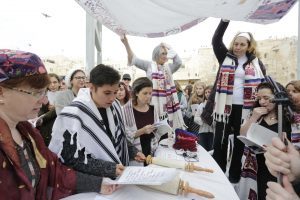
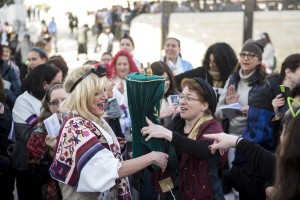
Rosh Hodesh. Over five-hundred women came together to peacefully pray and read words of Torah together at a service organized every month by the group
Neshot HaKotel, or
Women of the Wall. This time they had even more obstacles to overcome than usual.
In a groundbreaking ruling, the Jerusalem District Court upheld an earlier decision that women who wear tallitot at the Kotel plaza are not contravening “local custom” or causing a public disturbance, and therefore should not be arrested — as they had been in the past. The issue of equal prayer rights at the Kotel has become more prominent recently because of the frequent arrests of women participating in these special services held each month on Rosh Hodesh — which has long traditionally been considered a special holiday for women in Judaism.
During the last Rosh Hodesh service at the Kotel, the scene was chaotic as a large police presence tried to keep the the protesters and women daveners separated. Haredi (Ultra Orthodox) women had gathered in large numbers to fill the women’s section in an attempt to prevent Women of the Wall from holding their monthly service. Meanwhile Haredi men and children hurled stones and insults in the direction of these women, simply trying to gather in prayer. Absolutely appalling.
I, like many of you have long supported Women of the Wall and their efforts on behalf of religious pluralism in Israel. Yet when I expressed that support in the comments section of Jpost.com I was greeted with the typical barrage of delegitimizers, and those who deplore any expression of Judaism other than their own.
But let me say it clearly. WOW’s actions are not at all contrary to halacha, (Jewish law) but haredim throwing rocks at people clearly is a grave sin in Judaism. There is no comparison. Halacha is dynamic, and there has never been only one authoritative interpretation of Jewish law. Our Sages have taught us that there are shivim panim laTorah (seventy faces to the Torah) and many modern Jews who support WOW are also living according to Torah. So those who say WOW and their supporters don’t accept the Torah are completely misguided.
The Kotel belongs to all Jews; not just the haredim, not just the Orthodox, and not just Conservative or Reform either. But even beyond that, ethical, moral and civil behavior should be expected of all Jews and in all places — but especially in a sacred space such as the Kotel.
Others objected to my words of support saying it’s a complex issue and the sensitivities in Israel are different than they are here in America. I couldn’t disagree more. It’s NOT complicated at all. I have davened at the Kotel many times over the years, and twenty years ago I could lead an egalitarian Kabbalat Shabbat service in the Kotel plaza without incident. But today there are haredi thugs who can’t accept that anyone has a right to any interpretation of Judaism other than their own narrow definition of Judaism.
The article on Jerusalem Post’s website where my comments appeared was titled: “Western Wall rabbi: I am hurting and crying”. Rabbi Shmuel Rabinowitz told the Post: It wasn’t for this Kotel that we prayed. We don’t want a Kotel of disagreement.”
Well I certainly agree. The Kotel should indeed be for all of us, praying together in harmony, each in our own respective way. The Kotel belongs to all Jews, not just those who delegitimize us. We modern Jews who identify with more progressive streams of Judaism are tired of having our voices shouted down. And refusing to even acknowledge our observance of halacha is an insult that we should no longer tolerate.
So I encourage you all to add your support to these brave women who are liberating the Kotel for the entirety of the Jewish people.
L’Shalom,
April 15, 2013 / by Women of the Wall / Make A Comment / Filed under Divrei Torah
When a woman cannot mourn….
The stones of the earth will shake.
The rains will flood
… The seas will swell
The earth will open
The Shekhina will wail!
She will moan…
Until every woman can cry
Until every woman can sing
Until every woman can laugh
So deeply that every man will feel
Called from the depths of his soul
To cry with her
To sing with her
To laugh with her
And to dance with her
Before the sun
Before the moon
Standing in the River of Life,
Holiness beating in their hearts.
Their bodies dust,
Their breath divine
Written by Jennifer Rudick Zunikoff, April 4, 2013
March 31, 2013 / by Women of the Wall / 1 Comment / Filed under Divrei Torah, In Our Own Voices
Women of the Wall Rosh Hodesh Nissan
by Allison Cohen, a rabbinical student attending Hebrew Union College-Jewish Institute of Religion, the first year of the program is spent at HUC’s Jerusalem campus.
As a rabbinical student, I am constantly reminded of one of the greatest skills I have been taught: the act of questioning. Who, what, where, when and my favorite, “why?” In each class, I take what I learn, question it, reason with it and apply it to society.
This past month’s Women of the Wall Rodesh Hodesh service not only celebrated the new month of Nissan, but also marked the month of the Jewish holiday of freedom, Passover (Pesach in Hebrew). During the Shacharit service, no women were detained, and just like last month, we prepared ourselves for the guards to be standing at the security checkpoint where we would exit from. As we made our way to Robinson’s Arch for the torah service, all of the women linked arms. I was linked in between two women who were in Israel for the Women of Reform Judaism’s Centennial Celebration. Everyone walked closely together as we sang Oseh Shalom. We waited for the guards to tear each other from our links, but to our surprise, no event occurred. Instead, we continued peacefully to Robinson’s Arch.
.JPG) |
| Women of Reform Judaism’s Vice President Susan Bass & Alli Cohen (me) |
As wary as I am to an unexpected, quiet Rosh Hodesh, I know I need to stay hopeful. Nevertheless, Passover reminds me that in many ways, it seems we are still enslaved today. My involvement with Women of the Wall makes me question: How can we rejoice, when we cannot even have the freedom for religious expression, even in Jerusalem?
Jews especially love to ask questions, and this is quite evident through Passover. We have just asked ourselves four, very famous questions, and as the youngest child in my family, I may never retire from having to sing: מה נשתנה, הלילה הזה מכל הלילות
(Why is this night different from all other nights?)”
However, I would like to propose a fifth question of my own: Why is this month different from all other months? This is the month of freedom. This is the month in which we recall the bitter times of our past but also the journey out of exile. Despite our past detainments and arrests, let this Rosh Hodesh and the recalling of the Passover story give reason to hope. Let it empower us to continue the struggle towards the freedom that we see just, for our own lives today.
Looking ahead, maybe Pesach teaches us that we need to continue asking in order to shape a brighter future. After all, the holiday is not just about remembering the time in slavery, but the journey our ancestors took; this journey continues today. So if it is up to us, maybe we should be asking: What can we do to create an atmosphere for religious pluralism in the public domain? How can we share a site that is sacred to a variety of people? How can we allow room for religious expression when it may go against our own beliefs? How can we enable the Kotel to truly be a place for all to find meaning? Just as a journey cannot be taken while stationary, neither can our need for continued questions cease. In order to move forward with ever-changing times, we must continue to question. As a student I have learned that ultimately, life is not about having all the answers but knowing that there are always more questions to be asked.
On Pesach many sing the song Bashana haba’ah, by Ehud Manor. Translated to English, the chorus means: You will yet see, you will yet see, how good it will be, next year.
Let us make this vision a reality! Hag Pesach Sameach!
March 24, 2013 / by Women of the Wall / Make A Comment / Filed under Divrei Torah, In Our Own Voices, In the Voices of Our Supporters
by Rabbi Iris Richman Pesach/Passover 5773/2013
The celebration of Pesach and the reading of the timeless Haggadah from year to year requires a deeper and broader understanding. We are not just obligated to tell the ancient story, but we are also required in each generation to see true liberation through our own eyes and in our own times.
It is not just that the ancient Israelites went out mi-mitzrayim. We did that to arrive somewhere else. As our Torah and Haggadah tell us, the liberation was to enable us to achieve a holy purpose. “God took us out from there in order to bring us and give us the land that God swore to our ancestors.” (Deut. 6:23)
For each of us, that liberation mi-mitzrayim may mean something different. In the literal sense, being liberated mi-mitzrayim means the original Exodus that took us from Egypt. Yet, Rabbi Nachman of Bratslav said: “The Exodus from Egypt occurs in every human being, in every era, in every year and even on every day.” Moreover, mi-mitzrayim also means from the narrow places – meaning that this liberation that we require and celebrate is not only from Egypt, but also from those narrow places that constrain us and prevent our full spiritual and religious expression as Jews.
Tonight, as we give thanks for that ancient liberation which enabled us to enter the holy land of Israel, let us remember that the process of liberation is not complete. As the next verse of the Torah makes clear, this liberation was infused with obligation. We were liberated in order to worship God for our lasting good.
When we celebrate what God did for us – us is neither male nor female, not Orthodox, Conservative, Reconstructionist, Reform or Renewal. It is simply us, the Jewish People.
Let us join our Jewish Voices Together and say that all Jews must be liberated to serve God and to worship each in his or her own true way, especially at the place that God showed us, where our ancestors united to worship – the Kotel/Western Wall.
Let us envision a next year in Yerushalayim/Jerusalem where women and men alike can worship at the ancient site of the Kotel, free from harassment or arrest, including those who wear tallitot and tefillin containing verses of Torah in order to be brought yet closer to God.
Let us see, this year, through our own eyes, religious tolerance and love for one another in supporting one another to each achieve our highest holy purpose
Rabbi Iris Richman Pesach/Passover 5773/2013
Facebook: https://www.facebook.com/pages/Jewish-Voices-Together/498144213555140?fref=ts
Web: http://www.meetup.com/Jewish-Voices-Together-NYC/about/
Twitter: https://twitter.com/JVoicesTogether
Email for more information: JewishVoicesTogether@gmail.com
March 24, 2013 / by Women of the Wall / 2 Comments / Filed under Divrei Torah
by Sherree Beth KaneGraber
Rabbinic Intern, Newburgh, NY USA
Shabbat Shalom!
Today’s service & Torah reading is dedicated to The Woman of the Wall.
About 25 years ago, in shul one Shabbas morning a man came up to me and told me that I should not be wearing a tallis. He was rather unpleasant in his tone.
The man interrupted his prayer to approach me to tell me what I couldn’t wear.
I was confused! Part of why I was confused was that I was wearing a scarf.
Rather than tying it, I wore the scarf on my head, loosely flowing onto my shoulders. I loved my silvery grey fringed Shabbas scarf. Occasionally I wore a white linen hat, but most of the time I chose the scarf because the enveloping feeling while praying felt right to me.
It felt natural. It became part of my Shabbas ritual. In Parshat Vayikra we read about ritual. The parsha describes in graphic detail what, when and how the korbanot, offerings, are to be made.
Korban, the word for offering, is based on the Hebrew root koof reish beit, karav, which means to draw close; the Hebrew word for near is based on this same root.
Our ancestors had ritual which helped them facilitate feeling closer to Hashem. There were many kinds offerings, which included animals of various kinds, oils, as well as flours.
Today our rituals are different than those of our ancestors, however we too seek closeness to Hashem and pursue spiritual experiences.
When we put on Tallit, there is a ritual. Some people first recite a prayer as part of their preparation, and also check to see if the tzittzit, fringes are all intact.
We hold the tallis in front of us as we recite the b’rucha shel mitzvah, the blessing of commandment (Baruch…) לְהִתְעַטֵּף בַּצִּיצִית ….
Blessed are You, our G!d, Ruler of the Universe, Who makes us holy with Your commandments,… and commands us to wrap ourselves in fringe
We kiss each side of the attarah;
We swirl the tallis around to cover our body /
Some people wrap only around their head / some of us wrap the tallis around our entire body and say a private meditation; and them lower to let the tallis rest on our shoulders.
This is but one of the many, beautiful rituals that we have. And we have the right and the freedom to practice our rituals and to seek our own spiritual experiences.
Here In Newburgh I can proudly, and safely wear my tallis.
The rules that are enforced at The Western Wall
הכותל המערבי are as if the Kotel was an orthodox shul.
There are women in Israel being arrested for wearing tallitot; for carrying Torah, and for raising their voices in prayer.
What would it feel like to have someone say you can’t wear your tallis or your kippah when you pray?
What would it feel like to have someone rip the Torah out from your arms?
How would you respond to being shouted down when you were trying to sing the beautiful music of Hallel?
This is what happens in our Israel on Rosh Chodesh, when The Women of the Wall meet to celebrate the new month.
In honor and support of the Women of the Wall, I would like to share with you a prayer written by Rahel Sharon Jaskow
May it be Your will, our God and God of our mothers and fathers, to bless this prayer group and all who pray within it: them, their families and all that is theirs, together with all the women and girls of your people Israel. Strengthen us and direct our hearts to serve You in truth, reverence and love. May our prayer be desirable and acceptable to You like the prayers of our holy mothers, Sarah, Rivka, Rahel and Leah. May our song ascend to Your Glorious Throne in holiness and purity, like the songs of Miriam the Prophet, Devorah the Judge, and Hannah in Shilo, and may it be pleasing to you as a sweet savor and fine incense.
And for our sisters, all the women and girls of your people Israel: let us merit to see their joy and hear their voices raised before You in song and praise. May no woman or girl be silenced ever again among Your people Israel or in all the world. God of justice, let us merit to see justice and salvation soon, for the sanctification of Your name and the repair of Your world, as it is written: Zion will hear and be glad, and the daughters of Judah rejoice, over Your judgments, O God. And it is written: For Zion’s sake I will not be still and for Jerusalem’s sake I will not be silent, until her righteousness shines forth like a great light and her salvation like a flaming torch.
For Torah shall go forth from Zion and the word of God from Jerusalem. Amen, selah.
When I put on my tallis; when I proudly carry our Torah around our sanctuary; when I sing Hallel on yontef; I think of the Women of the Wall.
Shabbat Shalom
March 20, 2013 / by Women of the Wall / Make A Comment / Filed under Divrei Torah, In Our Own Voices
by Bonna Devora Haberman, a founder of Women of the Wall, author of Israeli Feminism Liberating Judaism: Blood and Ink
Click to download printable version or click here to read more
Women of the Wall Supplement for the Pesach Seder
Before we dip our fresh greens into salt water, we recite this intention together -
Holy One
who birthed the Children of Israel from the narrow confines of bondage
through waters of redemption onto dry earth
who suckled us on moist manna and
led us by fire and cloud to our promised homeland
bless us at this seder table
to instill in ourselves and one another
deep and loving yearning for liberation
in our day.
Tonight, this salt water
recalls millennia of tears shed at the Kotel – the Western Wall
remnant of our ancient Jerusalem Temple, our sacred home.
Tonight, these greens signal Israel spring
women rising up
steadfast in our commitment to the full, inclusive expression
of women’s prayer, participation and leadership
at the Kotel
and throughout Creation.
דרש רב עוירא, בשכר נשים צדקניות שהיו באותו הדור נגאלו ישראל ממצרים
Rav Avira explained: As the reward for the righteous women who lived in that generation, the Israelites were delivered from Egypt.
Talmud Sota 11b
Tonight, we draw greens from salt water
we shake off tears of bondage and exile.
We ingest ancient Passover passion and courage
to ever render all human habitation
and our precious Jewish homeland
a more redeemed state.
Next year in Jerusalem!
May this be Your will. Amen.
Text © 2013 Bonna Devora Haberman, a founder of Women of the Wall, author of Israeli Feminism Liberating Judaism: Blood and Ink.
Graphic © 2013 Shmuel Browns
March 18, 2013 / by Women of the Wall / Make A Comment / Filed under Divrei Torah, In the Voices of Our Supporters, Reports of Solidarity, Solidarity
by Anita Silvert
I started leading women’s Seders about 25 years ago, and I was late to the table, so to speak. My sister Jan Salzman, who is now a rabbi, got our family started with a homemade Haggadah, and my two sisters and I, our mother, aunts, and girlfriends left kids and husbands at home, and joined together for a third Seder, just for women.
In fact, our daughters weren’t allowed at the table until they had become bat Mitzvahs. This was a women’s Seder, It was a liberating experience to be without the men back then. We still prepared the meal, but we prepared and served it together. It was, for some of us, the first time we had all sat unrushed through an entire Seder.
I still lead women’s Seders today, although some of the language that refers to being equal in ritual practice may seem outdated in many communities. We are less and less fighting for our voices to be heard in Jewish life, at least in this country. There are still ritual issues to be addressed, such as the “agunah”, both here and abroad, the plight of the “chained wife”, whose husband refuses to give her a Jewish divorce, which keeps her chained to a marriage that may have already been ended through civil divorce, but from which she cannot leave in light of Jewish law. Sadly, the language about violence toward women, inequality in the workplace, and the glass ceilings are still apropos. Year after year, we still find something meaningful in the familiar words and rituals, even if it’s to remember how far we’ve
come from those decades ago.
Over the years, there have been new twists to the liberation story, as reflected in the number of themed Haggadot available: Soviet Jewry, Social Justice, Interfaith, LGBT, and so many, many more. Because the story is so powerful, because the story is so true and profound at its core, others who are under the yoke of oppression find inspiration in it, too. Passover is about an entire group of people who are finally allowed to take part in their own
destiny. Passover is about recognizing the continuing struggle for freedom. Passover is about telling and re-telling a story that still resonates through the generations, as we are told, “k’ilu hu yatza m’Mitzrayim”, as if we personally were brought out of Egypt. Passover is personal.
Recently, women have once again become the focus of another manifestation of the liberation story, and ironically, the struggle is taking place not only within the Jewish community, but at its heart, the Western Wall in Jerusalem. For over 20 years, members of an organization known as “Women of the Wall” have been gathering at the Kotel,on Rosh
Chodesh, the first of the month, to pray. I have davened with these women, and I have never known such elation, fear, uneasiness, and pride all at the same time. But the attacks on the Women of the Wall have been getting more and more violent, more and more humiliating, and more and more intolerable.
For Rosh Chodesh Adar, just last month, the Women of the Wall were joined by some other well-known liberators: the soldiers who liberated the Wall in 1967. Back then, they fought to make the Wall accessible to Jews. Now in their 70’s, with their presence, they are still fighting to make it accessible to all Jews. When these Israeli heroes joined the women, the police were not to be seen. But after they left, acting on the authority of the increasingly
radical Western Wall Heritage Fund, the police arrested and detained ten women who had the audacity to offer praise and gratitude to God while wearing the traditional garb of the prayerful – a talit. The police knew they couldn’t make these arrests in the presence of Israeli heroes, because the country would not have tolerated such an affront to
its deservedly revered warriors. But as soon as they were gone? All bets were off, and ten women were carted off.
Rosh Chodesh Nisan, for the month of Passover, seems to have gone more smoothly. Perhaps a tide is turning? Perhaps some of Israel’s leaders are beginning to pass through from their own narrowness, their own Mitzrayim, into a more open land? Just like the Israelites at the shore of the Sea, about to cross into an unknown land, perhaps the
leadership is also standing at the shore, and it will take the courage of Nachshon to step into the water. We wish for them to find that courage.
The struggle for liberation continues throughout the world, and Passover is the appropriate time to shine a light into those dark places. How much more so do we need to shine that light on our own community, for the right to pray and live as the Jews we are. The original Exodus took faith and action, and we need both again today. This year at your Seder table, may you be inspired and strengthened by the story of the struggle, and may we all work together to find the way to true liberation in our own time.
March 11, 2013 / by Women of the Wall / Make A Comment / Filed under Blog, Divrei Torah, In Our Own Voices
by Natalie Bergner, Women of the Wall Intern
Two weeks ago I stood with Women of the Wall for our reading of the Meggilah. Women came in costume with smiles on their faces and graggers in their hands, ready to celebrate the strength of Ester and the Jewish people. For the first time since I have been an intern at Women of the Wall, there were no arrests. The Kotel was basking in the first rays of spring sunlight and the Women of the Wall were allowed to peacefully enjoy the peaceful Purim atmosphere.
Tomorrow morning Women of the Wall will gather to celebrate the coming of Rosh Hodesh Nisan. The month of Nisan marks the first Rosh Hodesh of the Jewish people. “The Lord said to Moses and to Aaron in the Land of Egypt: This month shall mark for you the beginning of months; it shall be the first of the months of the year for you.” (Exodus 12:1-3) It is also known as Hodesh haAviv, the month of Spring. For the duration of Nisan the Jewish people celebrate our exodus from Egypt and entry into freedom. We remember and honor the prophetess Miriam, sister of Moses and Aaron, for her bravery in saving the baby Moses and her gift of water that she provided the Jewish people in the desert. We sing to Miriam at the Passover Seder, proudly recalling the strength of our female ancestor.
In such a month of new beginnings and celebrations of liberation, I hope that this time of year will mark a new chapter for Women of the Wall—a time in which women will be liberated from having to hide their Tallit, their voices and their Torah. I hope that just as Miriam sang in peace with her brothers and sisters in the desert, the Women of the Wall will be able to read, pray and sing in harmony tomorrow morning, and that this morning becomes an example of peaceful Roshei Hodesh to come.
February 24, 2013 / by Women of the Wall / Make A Comment / Filed under Divrei Torah, In Our Own Voices
By Rabbi Pamela Frydman, Co-Chair, Rabbis for Women of the Wall
In Mishnah Megillah[1] chapter 2, section 4 (see also Babylonian Talmud, Tractate Megillah 19b), it states: “All are qualified to read the megillah except a deaf person, an imbecile and a minor. Rabbi Judah declares a minor is qualified.”
In the Gemara (Babylonian Talmud, Tractate Megillah 4a), it states, “Rabbi Joshua ben Levi (also) said: Women are under obligation to read the megillah, since they also profited by the miracle then wrought.”
There is a halakhik principle, which is derived from Mishnah Rosh Hashanah chapter 3, section 8, that a person who is obligated to perform a mitzvah may fulfill the obligation of others who are also obligated to perform that mitzvah.
Rashi, in his commentary on Arakhin (Babylonian Talmud Arakhin 3a) takes the position that women are obligated to read the megillah and they are fit to read the megillah and they may, through their reading of the megillah, fulfill the obligation of men to hear it. Rashi bases his position on Mishnah Rosh Hashanah 3:8 cited above.
In the Shulkhan Arukh (OH 689:1-2), it states that women are obligated to read megillah the same as men.
Rabbi Dov Linzer, Rosh HaYeshiva and Dean of Yeshivat Chovevei Torah Rabbinical School in New York, writes:[2]
“The Gemara states[3] that the phrase “all” is meant to include women, with the implicit conclusion that women have the same obligation in megillah as men, and can read for men.”
Rabbi Linzer goes on to write, “Rashi, Rambam, and many rishonim rule accordingly. Tosafot, however, quotes Hilkhot Gedolot who quotes a Tosefta that states that women are exempt. Rather than rejecting the Tosefta, it is reconciled with our Gemara to mean that women are exempt from reading the megilah, but are obligated to hear it. Thus, our Gemara which says they are obligated and can read, only means that they are obligated to hear, and can only read for other women with a similar level of obligation. This leads some Rishonim to even suggest an alterante brakha for women (lishmo’ah megillah).
“Shulkhan Arukh (OH 689:1-2) rules that women are obligated the same as men, but he does note the dissenting opinion.
“Rema rules like Tosafot, that woman cannot discharge men’s obligation, and even quotes the opinion that they must make a different brakha.”
Rabbi David Golinkin, President and Professor of Jewish Law at Machon Schechter[4] in Jerusalem, writes:[5]
“…Indeed, many if not most Orthodox rabbis do not allow women to read the Megillah in public or only allow them to read the Megillah for other women. However, if one follows the general rules of Jewish law it is clear that the Babylonian Talmud takes precedence over the Tosefta and the Yerushalmi (see Entziklopedia Talmudit, s.v Halakhah, Vol. 9, col. 247, note 108 and col. 250, note 147).
Indeed, this is exactly what the Or Zarua and the Meiri state explicitly regarding our topic. The Or Zarua (Part II, parag. 368, fol. 77d) says that since the baraita in the Tosefta is not mentioned in our Talmud, we do not rely on it, and it seems to me that the main thing is as Rashi explained: to include women who are obligated to read the Megillah and fit to fulfill the obligation of men.
The Meiri states (in his commentary to Megillah, p. 21):
And the main thing is not to push aside an explicit Talmudic passage in our hands by a baraita (i.e. the Tosefta) or by the Western Talmud (i.e. the Yerushalmi) and how much the more so by logic, but let us rely on the well-known principle that “all who are obligated in something fulfill the obligation of the public”.
Therefore, it is clear that according to the Babylonian Talmud and a large number of early authorities, women are required to read the Megillah and can therefore read the Megillah in public for a congregation which includes men. This is not some modern innovation but the most authoritative halakhic opinion on this topic. Furthermore, it also stands to reason as three of the Rishonim state that women may be counted in the minyan for the Megillah reading.”[6]
Based upon these and other sources, Women of the Wall gather on Shushan Purim to read Megillat Esther at the Kotel, the Western Wall in Jerusalem.
[1] All references to “Megillah” in this article refer to the Megillah of Esther read on Purim.
[2] “Arakhin 3 – Women & Megillah, Women & Zimmun, Minors & Zimmun” by Rabbi Dov Linzer, The Daily Daf, Thoughts and Insights on the Daf Yomi, January 16, 2012. <http://www.the-daf.com/talmud-conceptual/arakhin-3-women-megillah-women-zimmun-minors-zimmun/>
[3] Rabbi Linzer is referring to Mishnah 2:4 cited above.
[4] Schechter Institute of Jewish Studies, Jerusalem, Israel
[5] “May Women Read the Megillah in Public?” by Rabbi Golinkin, Responsa in a Moment, Volume 6, Issue No. 4, March 2012. <http://www.schechter.edu/responsa.aspx?ID=64>
[6] Rabbi Golinkin dedicated this Responsa to the memory of his Mother Blume Devorah bat Esther z”l on the occasion of her shloshim, 28 Shevat 5772.
January 4, 2013 / by Women of the Wall / Make A Comment / Filed under Divrei Torah
by Anita Silvert, from her site Jewish Gems
Good morning class and welcome to Civil Disobedience, 1:15 (Exodus chapter) , or as the saying goes, “Well-behaved women seldom make history.”
Today we meet two of those uppity women, Shifra and Puah, Hebrew midwives during the time of the Hebrew enslavement in Egypt. Confronted with one of the most harsh and intolerant decrees possible, the murder of newborn baby boys, these two women said, “Enough.” Quietly, but with great passion and purpose, they set about defying the government’s decree. Pharaoh was afraid that the oppressed people would become too numerous, would join forces with other enemies of the State, and overthrow him. So he set about hitting them where it hurt most – their families.
Shifra and Puah simply refused to carry out the Pharaoh’s decree. They wouldn’t kill the babies, or allow them to die (depending on your perspective). When they were called on the carpet, so to speak, to answer for the fact that there were still baby boys living past infancy, they simply said that the Hebrew women were so strong, they couldn’t get to the birthing fast enough to do what the law required. Oops, Sorry Pharaoh, but not our fault. And history was made when one of those baby boys grew up to lead the entire nation out of slavery.
Uppity women change the world, and they are still doing so. As you have read in this space before, the battle for ritual equality continues in Jerusalem, supposedly the spiritual homeland of all Jews. You would think, when we women travel to Israel, we would feel at our most spiritual, our most fulfilled as Jews. To walk in the steps of our history, to see and sense our ancestors’ encounters with God, to pray at the sites of our ….oops. Sorry. Forget that last oneS.
Still and still, worse and worse, the situation at the Western Wall is giving women something to wail about. Still and still, more and more, women are required to feel less and less connected to this holiest site as active, participatory ritual-evolved Jews.
Women of the Wall (www.womenofthewall.org.il) leads the fight of uppity women, led by the uppityist of all, Anat Hoffman. For over 20 years, they have gathered at the Wall to pray. Simply to pray. And for that offensive, outrageous desire to express praise and gratitude to God every Rosh Chodesh (new month), they are attacked, harassed, and arrested. Why? Because the government is “afraid that the oppressed people will become too numerous, and join forces with other enemies of the State, and overthrow [them]”. Wait. Did I just write that? Yes I did. Indeed, women all over the world are joining forces to overthrow the oppressive, discriminatory rulings of the Israeli government-backed “Authority” at the Western Wall.
According to midrash (commentary/tale) after Shifra and Puah took their stand and made an impact on the Hebrew community, Miriam convinced her parents to re-marry after the government had forced them apart, in another attempt to keep the enemy-population down, and their union produced Moses. Where uppity women lead, others follow.
Last month at the Wall, uppity men “smuggled” in the contraband tallitot (plural of tallit, prayershawl) for the women who came to pray. This is what it’s come to? Check out the Women of the Wall website for the latest round of decrees, as reported in the New York Times The police/government, laying down and taking orders from the ruling Ultra-Orthodox “authority” of the Kotel (Wall) plaza, is forbidding women to bring in any religious ritual items…like a prayerbook, perhaps? Is that what’s next?
Prime Minister Benjamin Netanyahu said he has finally heard the voices of women and men around the Jewish world, and he has formed a committee to come up with a solution. The Jerusalem Post reports, however, that the committee, headed by Natan Scharansky, hasn’t even been given a clear mandate for what he’s supposed to be heading up at all.
Shifra and Puah went before the Pharaoh and lied through their teeth, so that they could continue doing the work they intended to do. They prayed with their hands, each time they brought another “contraband” baby into the world. Today, Jewish men and women from all over the world are forced to do the same thing, lying and smuggling in “contraband” religious articles, just so they could pray with their hands and bodies, voices and souls. The Pharaoh/Rabbi is afraid, but the people will rise up and be freed by those uppity women who have come to pray. God will hear them as clearly as God heard the soul-cry of Shifra and Puah, leading them onward to liberation.
They come to pray.
December 19, 2012 / by Women of the Wall / 1 Comment / Filed under Blog, Divrei Torah, In Our Own Voices
By Rabbi Laura Geller is the Senior Rabbi of Temple Emanuel in Beverly Hills, California
We approached the entrance to the Kotel Plaza a little before 7:00 A.M. on Rosh Hodesh Tevet. In my bag was my tallit, the beautiful purple and blue one that was hand woven as a gift from the students and faculty at USC over 20 years ago when I completed my time there as the Hillel rabbi. Several women were in line in front of me; the security guards checking bags told them they couldn’t bring their tallitot into the Kotel Plaza. As of 6:00 A.M. that morning, a new decree had been issued by the “Rabbi of the Wall”, forbidding women from entering the plaza with Jewish holy articles like tallit and tefillin.
This week’s Torah portion continues the story of Joseph. It begins: “Vayigash eilav Yehuda… And Judah approached him (Joseph)…” The midrash (Bereshit Rabba 93:6) asks what “approach” means, what are the different strategies one might use to approach those who hold power. It offers three options: one is to approach in conciliation; the second is to approach in battle and the third is to approach in prayer.
I wanted to approach in prayer. I learned long ago of the power of tallit and kippah to help me move from the secular to the sacred, spiritual tools that begin the transformation that opens my heart to prayer. I took my tallit out and wrapped it around my neck like a scarf. When it was my turn to go through security, a guard pointed to my neck. “Does that scarf have tzizzit? Take it off. You must leave it here.” I tried to explain: “But I am coming to pray. In the mornings I pray with a tallit. This tallit is very symbolic to me—it was a gift from the students I taught that there is more than one way to be a Jew.” But as he was going through my purse and holding my kippah in his hand, he didn’t seem interested in a conversation. “You can take this, handing me the kippah, but not that tallit”
I unwrapped the tallit and left it in the pile of tallitot other women had been forced to leave behind. Four women who
wore their tallitot under their coats were able to pass through security. When they reached the women’s section of the kotel and our prayer began, they put on their tallitot, and were soon summoned by the police and told they must take them off or leave the group. Subsequently they were arrested.
There is no halachic prohibition against a woman wearing a tallit. At most the prohibition is against saying a bracha that indicates she is fulfilling a commandment. We actually have evidence in rabbinic tradition that some daughters of certain prominent rabbis wore tallit and tefillin. So why is my wanting to approach the Kotel in prayer, the way I pray, a problem for the authorities who control the Kotel? If I can’t approach in prayer, in what for me is real and authentic prayer, the only options left are to approach in conciliation or in battle.
I could approach in conciliation. I could argue that Women of the Wall have been given what we need— we are “allowed” to convene eleven times a year in the women’s sections for public prayer, as long as we move to Robinson’s Arch for the Torah service. There we can wear tallitot and tefillin; there it is possible to have women and men pray together. But Robinson’s Arch, while technically part of the Western Wall, is not the “main” Kotel, not the iconic symbol that so many Jews consider sacred. The Kotel is sacred space that should belong to all Jews. It is in fact a national monument. The problem is that government legislation has turned it into an Orthodox synagogue where public prayer can only be led by men. It disenfranchises me along with the vast majority of Jews in the world. It says that my expression of Judaism is not authentic. Conciliation means giving up my own voice and my own truth.
So the only approach that is left is battle. Women of the Wall will continue to fight the battle, not only for reclaiming the Kotel as public space, but also for all the other issues of religious pluralism that are so important. We will continue to speak truth to power, raising our voices and our prayers to challenge the Orthodox monopoly on issues of personal status: marriage, divorce, burial and conversion, and to work for parity in government funding for non Orthodox religious and educational institutions and for recognition of liberal rabbis.
November 8, 2012 / by Women of the Wall / Make A Comment / Filed under Divrei Torah, In Our Own Voices
Sent by Chaia Beckerman, member of Women of the Wall International Advisory Board
Taken from a Dvar Torah given by Rabbi Joel Berman at Temple Beth Emet in Anaheim, CA, October 20, 2012
It’s Parshat Noah, when our thoughts turn to rain, and we read it around the time we start asking for rain every year. In reading the parsha this year I noticed something I hadn’t really seen before. You might remember that when the flood was over, Noah sent forth three birds. The first bird came back; it had nowhere to land. The second one came back with a twig in its mouth, indicating there was some dry land around somewhere. The third time a bird was released, it didn’t come back….The rain had stopped, and the bird had the sense to stay out.
What I noticed is that apparently Noah did not share this bird’s common sense.…Noah showed no initiative or gumption of any sort…. Four times we find Noah blindly doing all that the Lord commands him. When the bird did not come back, indicating the earth could now sustain life, Noah, even though he had been on the boat for little over a year by some counts, did not get off the boat on his own steam. Maybe the thought of starting the human race over again almost from scratch was intimidating him? Maybe he had another reason? He is judged harshly for this in the Midrash. In Midrash Tanhuma we read:
Once the waters had abated, Noah should have left the ark. However, Noah said to himself, “I entered with Gd’s permission, as it says, ‘Go into the ark’ (7:1). Shall I now leave without permission?” The Holy One, blessed be He, said to him, “Is it permission, then, that you are seeking? Very well, then, here is permission,” as it is said ‘Come out of the ark. ‘”
Rabbi Yehudah bar Ilai said: If I had been there I would have broken down the door to the ark and taken myself out.
….At least two of the animals on the Ark were dogs. Many of you know that our family recently acquired a dog…. I just saw a funny internet picture of a little pug with a really worried look, and the caption read, “I don’t know, man, what if I never find out who’s a good dog?”…What is a good dog? … A good dog is an obedient dog. Our dog is… in process. He’s got a touch of dyslexia, thinks he’s God. But a good dog, by most accounts, is an obedient dog.
Now, what is a good person? It’s not a person who is blindly obedient. In fact we are a people of commandments. How many commandment s are there in the Torah? Right. 613, plus all the thousands of detailed regulations and rules spelled out in such works as the Shulchan Aruch. Thousands of rules, regulations, and commandments. So what’s the biblical Hebrew word for “obey”?
The closest we come, and the word we typically find, is shma. LiShmoa. To listen, hear, attend, understand, internalize, or respond. It’s hard to translate all that into English. British Chief Rabbi Jonathan Sacks points out (Covenant & Conversation 5767: Noach) that the King James version of the Bible had to invent a word for shma: hearken. And since we almost never use that word anymore, we’re kind of back to square one. But one thing I think it’s safe to say is, that’s not what Noah was doing. Noah did not internalize, or respond, or understand, or attend the word of the Lord; he anticipated the English language by five thousand years, and simply obeyed.
The tradition compares Noah to Abraham, who heard what Gd had to say, and had his own two sheqels to put in. Abraham protested, he argued vociferously with Gd if he thought Gd wasn’t living up to His own standards. We’ll see that in a couple of weeks when we read about Abraham pleading for the few innocent residents of S’dom and ‘Amorah. And it’s Abraham who the tradition holds up as a “good person,” not just relative to others at in his own time and place, as with Noah, but altogether.
Which brings me to a good friend of ours and something that just happened a few days ago.
Anat Hoffman is the chair of an Israeli organization known as Women of the Wall. Some of you are familiar with it. They’re a group of Jewish women from around the world who pray every Rosh Hodesh at the Western Wall, the Kotel, in Jerusalem, and they want every Jewish woman who chooses to, to be able to pray out loud, wear tallitot, and read from the Torah there. Right now there are prohibitions against doing any of that and a lot of opposition from the Haredim, the ultra-Orthodox Jews, when women try.
…Anat, with some Women of the Wall, was at Kotel with a large group of visiting Ladies of Hadassah during their convention in Jerusalem, and she was leading them in prayer when with no warning she was arrested, taken to jail, strip-searched, dragged on the floor in chains, put in a cell overnight—for praying and wearing a tallit at the Western Wall. The irony, to me, is that she was arrested for not blindly obeying the authorities at the Wall. For being more like Abraham, and not like Noah. If the closest the Bible comes to saying “obey” is “shma,” you should know that she was arrested just after saying the Shma.
I quote here from The Jewish Daily Forward from Wednesday:
“I was saying Sh’ma Israel and arrested for it. It’s just unbelievable,” she said in an interview from her bathtub, where she was soaking limbs bruised from being dragged by handcuffs across the police station floor and legs shackled as if she were a violent criminal. “It was awful.”
Hoffman has been detained by police at the Western Wall six times in the more than two decades that she has led Women of the Wall, a group which conducts prayer services in the women’s section at the start of each Jewish month. But on Tuesday night, when she was arrested for the crime of wearing a tallit and praying out loud, she was treated far more violently by police than ever before.
“…They dragged me on the floor 15 meters; my arms are bruised. They put me in a cell without a bed…I laid on the floor covered with my tallit.
I’m a tough cookie, but I was just so miserable. And for what? I was with the Hadassah women saying Sh’ma Israel.”
So I went to my rabbis’ listserve, where there is always an exchange of opinions on current events, and saw this posting by a colleague, David Seidenberg, aka NeoHasid, which I quote with permission:
I’ve been reading up on Anat Hoffman’s violent arrest at the
Kotel while leading Hadassah conventioneers in the Sh’ma, and guess
what? Hadassah has not made any statement nor is there any mention of the incident on their website. What can you find there? There’s an
article (actually photo-spread) titled “Hadassah Women Cause Chaos in Center of Jerusalem”–and it’s about the convention and Hadassah
women shopping. That’s at the top of their news feed. There’s also a
news feed from Haaretz which includes none of Haaretz’s articles
about the arrest.
So I went there, to the Hadassah website, and found that this rabbi was absolutely right that they had made no mention of Anat or her arrest. (He’s formed a “Wake Up, Hadassah” Facebook group in response.) But there were two things of note that were on the site. One was a rather bland statement—it had appeared in the meantime:
Hadassah Reaffirms its Support for Freedom of Worship at the Western Wall
In Jerusalem, at the National Business Meeting of the Centennial Convention of Hadassah, the Women’s Zionist Organization of America, delegates unanimously approved a resolution reaffirming its commitment to and support for freedom of worship for women at the Western Wall.
And then I searched the site for mention of Anat Hoffman, and found a whole page of blog entries, people posting about the arrest, and the one that caught my eye was the following:
As a lifetime Hadassah member, as well as a Woman of the Wall activist during my 18 years in Israel, I’m glad to see a resolution. I urge you for Israel’s sake to take seriously the threats to democracy, freedom of expression, and freedom of religion exemplified by Anat Hoffman’s arrest. I appreciate that the political and religious diversity of Hadassah’s membership makes it hard to go beyond “pareve” statements. Nonetheless, I’m confident that you can find ways to represent all of us and also be forceful and direct, as you translate this resolution’s commitment and support into action.
There were many entries echoing this sentiment, but I chose to read you this one because it was posted by my wife Chaia. I had no idea that I was going to find it there. I clicked on her little picture next to her comment and got to her Facebook page, which is covered with pictures of the kids and the dog.
Now, I support Israel, and on other occasions I have, and I will, deliver more positive stories. We are hoping to have a congregational trip to Israel this summer. And while I think it is important to let Hadassah know what you think through their website or just writing them, there are other considerations, and in the long run, our being aware of the situation and supporting our like-minded Jews through the Conservative Movement in Israel, known as Masorti, is one of those ways. We’ve worked very hard for thousands of years to have our own piece of land, our home, over where it belongs. We can’t let it be the only democracy on earth with laws that discriminate against Jews.
…I’ll close with one more statement taken from the Internet:
And when the Shma is recited in shul this Shabbat, every Conservative, Reform, and Orthodox rabbi should take a moment to express their outrage about what happened to a Jewish woman who just wanted to say the Shma out loud at the Kotel.
We’ve already said Shma Yisrael this morning. Some of us have said it twice. Let’s remember that it doesn’t mean just hearing, and it doesn’t mean obeying; it means the kind of listening we do before we make up our minds to do something. We say it one more time today, in the K’dushah for Musaf. Let’s put a little something extra into it then, and whenever we say it from here on out.
Shabbat Shalom.
October 31, 2012 / by Women of the Wall / Make A Comment / Filed under Divrei Torah, In Our Own Voices
By Anita Silvert from her blog Jewish Gems
Speaking truth to power takes chutzpah.
Questioning that the power really resides in who you’re speaking to takes it to a whole other level.
In this week’s parasha, Abraham speaks truth to God. God has decided to destroy Sodom and Gemorrah
because of their extreme immorality, and Abraham is understandably disturbed by this. He says, “Will
you sweep away the innocent along with the wicked?” (Gen. 18:23) And he continues: Far be it from
You to do such a thing…Far be it from You…Must not the Judge of all the earth act justly?”
That’s chutzpadik.
Abraham spoke boldly to God, bargained with God, and challenged God’s behavior – actually accused
God of acting immorally. Yet there was no argument but that God really did have the power. Abraham
challenged God on action, not authority.
It takes far more courage, but is far more necessary, to speak up against those that assume they have
the authority, and expose them for both their immoral actions and their inappropriate abuse of power.
Such is the case with Anat Hoffman, director of Women of the Wall. If you haven’t heard, WoW is an
organization of women who, for over 20 years, have gathered at the Kotel (the Western Wall) in Israel
on every Rosh Chodesh (New Moon) to pray. The Kotel plaza is segregated by gender, and the women’s
section gets smaller every year. Yet, these women, with whom I have had the honor of praying, show up
each month, carrying the Torah, some in tallitot (prayer shawls), prepared to sing, pray and get shoved,
harassed, pushed, sworn at, and sometimes physically attacked. Two weeks ago, Anat came to the
Kotel with reverence for Judaism and prayer, in her beautiful WoW tallit, and recited the Shma. She was
arrested. She was shackled at her hands and feet. She was dragged across prison cell floors. She was
strip searched. Read more here, if you can stand it.
Because she said the Shma in public, at the Wall. The statement of faith that has kept our people
together for thousands of years. And now, the few but shouting minority deem the Shma to be fightin’
words, pitting Jew against Jew? To say, “Shame!” doesn’t go far enough.
In an interview with Anat, she mentions that Israelis don’t seem as outraged by the situation as Jews
are around the world. Israel must import the outrage, and I for one, am truly outraged. I know that it’s
flat-out wrong for an extremist and sometimes violent minority to dictate who gets to act as a Jew, who
gets to “do” Jewish and who doesn’t. The Kotel is governed by the Western Wall Heritage foundation,
and has designated the Kotel an ultra-Orthodox synagogue, not a national monument. Actions that
offend the religious sensibilities of those in attendance are outlawed. Women of the Wall is trying
to dismantle the Western Wall Heritage Foundation, which has ruled the Kotel with an iron, ultra-
Orthodox hand, and re-convene it with voices from all Jews who wish to pray at this most profound and
spiritual site. This is not just speaking truth to power, this is calling out the ultra-Orthodox as no longer
entitled to the “power” they wield, calling them out on immoral behavior. I am not equating these men
with Sodom and Gemorrah, but they are acting in a way wholly incompatible with Jewish values and
sensibilities. They have been given so much influence over the site that even the Kotel police think it’s
acceptable to treat someone in such a shocking manner.
The truth is Anat is not Abraham; we all are. We all must speak out against the unspeakable. How?
Listen and then share Fran Gordon Naomi Less’ new song, “Sh’ma Israel”. Support Women of the Wall
and IRAC, the Israel Religious Action Center, so they can continue their work on behalf of all Jews who
feel that no one can tell you how to be Jewish. No one can tell you you’re not “Jewish enough” to act as
a Jew in Israel, of all places.
When Abraham became outraged at God’s own plan, and said, “Shma”, God listened. Are you listening
to those who say it now?
November 10, 2010 / by Women of the Wall / 4 Comments / Filed under Divrei Torah
By Cheryl Birkner Mack
What’s so important about the place where we pray? For more than 21 years, Women of the Wall have been making the claim that they have a place at the Kotel. Not at the front of the plaza, not in the men’s section, but at the back of the women’s section. When we were a small group, you could walk by us without noticing us, but of course, now with all the support we’ve received since Nofrat’s arrest, our place is bigger.
We battled in court to get the right to daven at the Kotel according to our custom–which for some of us means davening with talit

Photo by Tanya Hoffman
and tefilin, and for all of us means with wonderful, joyous voices singing, praying and reading Torah together.
We were offered Robinson’s Arch as the place for our tefila. Robinson’s Arch is beautiful and historic and a wonderful place for davening. So why aren’t we satisfied?
Because for thousands of years the כותל המערבי של בית המקדש (Holy Temple’s Western Wall)
has been the the place of Kedusha (holiness) for our ancestors and our contemporaries. Many people say “the Haredim have taken over the Kotel. Let them have it.” But we say, “It’s not theirs! It’s ours–all of the Jewish people’s!”
In the parsha we read this week VaYetze, Yaakov comes to a place as he flees from his family. What place is that? Rashi says this can only refer to Har Moriah–הר הבית and later, Yaakov dreams of angels ascending and descending the ladder to heaven. When he wakes up Yaakov says
אכן יש ה’ במקום הזה ואנכי לא ידעתי וירא ויאמר מה נורא המקום הזה
God is in this place and I didn’t know it.
He was awestruck and said “How awesome is this place!”
אין זה כי אם בית אלוקים וזה שער השמים
This is none other than the House of God and this is the gate of Heaven.
In the Talmud, it states that when Yaakov travelled towards Haran and arrived there, Yaakov said “Maybe I have passed the place where my ancestors prayed and I didn’t pray there. The place is הר המוריה (Har Hamoria) where Avraham prayed.
והוא השדה שהתפלל בו יצחק the field where Yitzhak prayed.
Yaakov saw value in praying in the place where his ancestors prayed, as do we.
Elsewhere in the Gemara it mentions that one who prays on Rosh Hodesh is privileged to see the Shekhina, the divine image of God. But I must tell you that when I daven on Rosh Hodesh at home or even a synagogue I don’t always feel that presence, but when I pray in this place I am often privileged to experience God’s presence.
So with your support we will continue to pray in this place where our ancestors prayed and we will one day pray here with our talitot and tefilin and our sefer Torah.

Photo by Tanya Hoffman
August 28, 2010 / by Women of the Wall / Make A Comment / Filed under Divrei Torah
By Phyllis Chesler and Rivka Haut
We dedicate this learning to our new granddaughters: Phyllis’s granddaughter, Lily Diana (Aviva Chaya), and Rivka’s newest granddaughter, Tova Nitzana.
Our founding ancestors are both admirable and flawed. They are chosen by God, but they are also only human beings whose desire for intimacy with the Divine leads to anguish as well as to redemption. Many rabbis have either denied their flaws or tried to justify them. They admire Abraham for his willingness to exile one son and sacrifice the other in the belief that God wanted him to do so. Praise for the Akedah appears throughout our liturgy and the story is read every Rosh Hashana. In contrast, the commentators blame Sarah for her cruelty towards Hagar and Lot for his ungodly, immoral ways.
We propose a radically different approach to these Biblical figures.
The sages, with a few exceptions, such as Ramban on Genesis 12:10, do not blame Abraham for pretending that Sarah is his sister and thus available to both Pharaoh and Abimelech. This deception is viewed as justified, reasonable, because it saves Abraham’s life.
According to Rashi (Genesis 11:29), Sarah and Lot share the same father and are either full or half-siblings. Abraham is both an uncle and a husband to Sarah and an uncle and a father surrogate to Lot. We maintain that what has been considered objectionable in both Sarah and Lot are traits they have actually learned from Abraham, their role model and religious leader. Our purpose is not to downgrade our ancestors. Rather, we wish to wrestle with morally problematic texts. It is not enough to “hold” by previous commentators, learned as they are, but to bring our era’s sensibilities, which includes feminist knowledge, to bear on the text. We are religiously obligated to do so.
Although the Torah does not explain why Abraham is the one whom God chooses, many Midrashic accounts teach that Abraham is the first person to recognize that there is one Creator of the world. Therefore, he tries to destroy idols and worships the one God. Abraham’s capacity to “break” with one past on God’s behalf might be one of the reasons that God chooses him. God perceives that, like Moses and Elijah, Abraham could do this. Abraham is the one who “crosses over,” he is Abraham “ha’ivri,” the man who crosses boundaries, rivers, and who aspires to move from this world to God’s world.
Abraham’s yearning to be God’s intimate compromises his ability to be close to humanity, including his own family. He strives to obey God’s commandments and is even willing to sacrifice his sons when he believes that God desires him to do so. At God’s bidding, and without hesitation, Abraham circumcises himself, i.e. he sacrifices a part of himself; he also circumcises his son Ishmael and other members of his household.
Abraham separates himself from others. He also separates family members from each other. For example, Abraham deprives his father Terach of his grandson by taking Lot, his deceased brother’s son, along with him. Lot is the only living survivor of his father Haran. According to some commentators, (Ibn Ezra on Gen.12:1), Terach lived for another sixty five years in Haran. Perhaps Abraham took Lot along as his surrogate son; perhaps Terach was no longer able to raise this grandson. However, this is also the first time we see Abraham severing a family relationship. It may also be an example of Abraham not following God’s commandment fully. Lot was part of Terach’s household. God directed Abraham to leave his father’s house, not to take it along. Perhaps Abraham’s “adoption” of Lot was also a lesson to Sarah about one’s option to parent through surrogate arrangements.
When Abraham and his retinue (Sarah, Lot, and their servants) first arrive in Canaan, Abraham nomadically wanders around building altars. Abraham is not seeking property, livestock or any earthly enrichment; he is only seeking intimacy with God. [Gen 12:7-8]. However, soon after their arrival in Canaan, a famine drives them to Egypt where food is plentiful. Suddenly, Abraham realizes that his wife Sarah is beautiful and as such, might be prey for any powerful man. To save himself, he tells Sarah to pass herself off as his sister. Otherwise, as her husband, he might be killed and Sarah taken anyway. This strategy turns out to serve Abraham well and puts him in a position to negotiate a “dowry” from Pharaoh when he takes Sarah for himself.
Abraham emerges from this episode a rich man—and in possession of Egyptian servants, which likely included Hagar. When the family leaves Egypt, the first sign of strife emerges amongst this formerly united band. Abraham’s and Lot’s herdsmen squabble. Abraham’s proposed solution is that the two camps should physically separate. In 13:8, he asks Lot to “please” (“na”) separate from me because we are brethren, family, and we do not want controversy to divide us. Abraham couches his request as if he is doing Lot a favor by offering Lot his choice of location. Abraham has already separated Lot from his grandfather and country. Now he is separating Lot from Sarah and from himself. Abraham is a master at separation. Lot now takes his uncle’s suggestion and goes off towards Sodom, where the pasture appears to be better.
The use of the word “na” suggests that Abraham uses this phrase on important occasions and when he tries to convince someone to do something they may not want to do. Abraham uses it when he pleads with God to spare Sodom; and, as we shall see, Lot uses it when he attempts to appease the mob in order to protect the angels. Sarah uses this word as well when she asks Abraham to take Hagar as his concubine so that Sarah will have a child through a surrogate.
What is the real reason behind the separation between Lot and Abraham right after leaving Egypt? Perhaps Lot is upset at the way Abraham sent their relative Sarah to another man. Lot may even be traumatized or disgusted by this act; thus, Lot himself may have been ready and willing to leave Abraham and Sarah. Their relationship is not completely severed; when Lot is taken captive, Abraham races to rescue him. However, Lot never returns to his uncle’s side. Before the destruction of Sodom, the angel suggests to Lot that he flee “to the mountains” [Gen 19:17] where, according to midrash (Rashi on Gen. 19:17), Abraham resides. Lot disagrees with the angel and requests a small town in the plains, not in the hills. [Gen.19: 19, 20].
Despite their physical separation, Lot has already been deeply influenced by his uncle and mentor. When the people of Sodom attempt to sexually use the men, who are really angels, Lot, ever the good host, a trait he may have learned from Abraham, offers them his virgin daughters instead [Gen 19:8]. From where did he get this idea? Perhaps from Abraham! Lot sees his uncle, the man who speaks with God, the man who is consumed with the desire to be intimate with God, treat his own wife as a possession who can be sexually bartered. Lot imitates Abraham’s behavior when he offers up his own daughters to the mob of Sodom. Actually, Lot does so in order to protect his guests, not merely to protect himself. This might be one reason Lot was worthy of being saved.
Sarah also learned about separating from family members and about using women sexually/reproductively from her husband’s behavior. Like Abraham, she left home to travel to a strange land. Like Abraham, who offered Sarah to Pharaoh, and like Lot, who offered his daughters to a raging mob, Sarah now offers Hagar to Abraham. However, Sarah does not use Hagar’s sexuality; she is only interested in Hagar’s reproductive capacity.
When we first meet Sarah, she is portrayed as a mostly silent partner to Abraham, an obedient wife. She is alone, childless, and without intimates, except for her two male relatives Abraham and Lot. She travels with Abraham and seems to acquiesce in his handing her over to be sexually used by two other powerful men. However, the text preserves a possible hint of revolt on her part. The Midrash emphasizes that the first time Abraham offers his wife to another man (Pharaoh), he uses the term “na”, please. [Gen12:11}. The second time, when he sends her to Avimelech [Gen 20:2 and see Rashi ad loc], Abraham omits “na.” The midrash speculates that this time Abraham had to order Sarah to go. Having once experienced being used as a sexual object, she did not willingly agree to a repeat performance. In addition, in our view, Sarah must have been deeply traumatized i.e. shamed, angered, humiliated, helpless. Modern research and clinical practice describe how trauma victims are often capable of treating some more vulnerable than themselves in a similar manner. Many abusers were, themselves, previously abused.
Upon leaving Egypt, materially enriched, still childless, and without her relative Lot, Sarah may feel more alone than ever. She is desperate and unwilling to wait passively until God provides her with a child. Sarah decides to use her Egyptian maidservant Hagar, one of the reminders of her victimization in Egypt, as a surrogate to provide her with a child. (Here is the precursor to what Lot’s daughters will do). Just as Lot became Abraham’s surrogate son, (perhaps Sarah’s as well), Sarah now wants to have her own surrogate child. Just as Abraham had earlier offered Sarah to Pharaoh, Sarah now offers Hagar to Abraham. Let us note that there are other examples of women in the Book of Genesis who initiate sexual activity on their own and through surrogates; their main goal is procreative. (Rachel and Leah, and even Potiphar’s wife who, midrashically, is seen as having had a prophetic dream about having a child with Joseph which is why she tries to seduce him). (Bereshit Rabbah, 85;2).
Sarah’s education about using separation to solve problems is long-lasting, Thus, when Hagar conceives, and becomes haughty towards Sarah [Gen 16:4], Sarah decides to send her away just as Abraham had sent Lot away. When Sarah asks Abraham to send Hagar away, she tells him: [Gen 16: 5]; “Chamasi Alecha.” The wrong done to me is your fault!” (JPS translation). This bitter and angry cry is shocking. It was Sarah’s idea to give Hagar to Abraham as a concubine! How can she now blame Abraham for having obeyed Sarah’s express order to have a child with Hagar in order that Sarah could “build herself up?”
Sarah’s strong words here represent the first and only time that she expresses her innermost feelings about what Abraham did to her. Here, she finally allows her deep anger at Abraham’s prior behavior to emerge. Hagar the Egyptian, in a real sense, is part of the reward that Pharaoh gave Abraham for Sarah’s services. Hagar is a constant, living reminder to Sarah of her husband’s mistreatment.
In finally giving expression to her anger, Sarah goes even further, invoking God to judge between herself and her husband. This is the first biblical reference to God as “Judge”. Perhaps Sarah’s conceptualizing of God as Judge inspires in Abraham the idea of God as Supreme Judge of All the Earth, since he subsequently echoes Sarah’s words when arguing with God about Sodom [Gen 18:25]. In this quarrel between husband and wife, Sarah does not even mention Hagar. She refers to Abraham as perpetrator, herself as victim, and God as Judge.
From this heated exchange, we learn that all along Sarah may have been inwardly seething at Abraham’s behavior in Egypt. Perhaps Sarah’s barrenness is due to her unexpressed anger at her husband which may have caused her to stop sleeping with him.
Sarah forces Hagar to flee and she eventually exiles her forever. The first time is when Hagar is pregnant. Sarah “torments” her until Hagar flees. Later, after Yishmael’s problematic behavior unsettles Sarah, she exiles both mother and son from their home—and with God’s agreement. (God has an important but different future in store for Hagar and Yishmael). Here again, we see the ripple effect that Abraham’s behavior has had on his family. For the first time, Abraham expresses pain about the loss of a relationship; he sees this separation as “very wrong.” Nonetheless, Abraham listens to God and ever God’s obedient servant, he sends Hagar and Yishmael away.
Of course, God does not instruct Abraham to send Hagar and Yishmael away with nothing to sustain them. But, having heard the word of God, Abraham does not busy himself with giving his son and concubine proper provisions. He just sends them away. We see him blindly following God’s directive and not trying to help their desperate plight. This is the only time that the Torah tells us about Abraham’s inner turmoil regarding Ishmael. We learn nothing of his inner struggle, if he had one, when Sarah taken was taken by two Kings; when he separated from Lot; when he set out to sacrifice his son Isaac. And yet, even if Abraham was pained, despite his great wealth, he sent Hagar and Yishmael into the desert with meager provisions. He did not even provide them with enough water.
What kind of mother was Sarah? We may assume that she was a loving mother to her son Yitzhak. Observing his half-brother Yishmael’s troubling behavior, she worries about Isaac’s spiritual welfare; she sends Yishmael and Hagar away, fearing that Yishmael will have a negative influence over Yitzchak. After Sarah’s death, when Yitzhak takes his new wife, Rivka, into his tent, we are told that he was at last comforted over the loss of his mother. This confirms that a strong and positive relationship existed between them. Since Issac’s marriage to Rivka took place some time after Sarah’s death, this further indicates that Yitzhak bore a great love for his mother and that his mourning was an extended one. Parenthetically, the relationship between Abraham and Issac does not seem to resemble that between his future grandson Yaacov and his future great-grandson Yosef, which was a far more emotionally attached relationship.
Let us now focus on Abraham. God sees that Abraham is willing to serve God fully. Abraham’s courageous dialogue with God about God’s ways before the destruction of Sodom signifies the degree of intimacy that Abraham has achieved with God. Abraham is able to ask God to be accountable to the ideal of justice that Abraham has perceived within God. Abraham’s strong sense of of justice leads him to assume that the God he loves represents perfect, Divine Justice, and he holds God up to God’s own ideal. And God, in response to Abraham’s pleading and bargaining, agrees to lower the threshold of righteous men from fifty to ten.
However, God continues to ‘test” Abraham to see how far a human being is able to rise above his “human” limitations. Will Abraham be willing to sacrifice his son Yitzhak? Abraham has held God to the highest level of morality as the “Judge of all the Earth”—which was originally Sarah’s phrase. Now, God is testing Abraham. Can a human being surpass his humanity and enter angelic territory? And if so, is this something that God wants from humanity? Is this desirable in a God-loving human being? God tests Abraham to see if he can overcome his natural feelings for his son and actually kill him. We believe that Abraham attempts to surpass the limitations of being human—and in so doing, displeases God. Perhaps God does not want human beings to blur the lines between being human and being angels.
Angels pervade the stories of Abraham. Angels have no bodily needs, they do not have family or human attachments, don’t get emotionally involved, have no free will, and are at one with God’s will. Angels are not complex entities nor do they seem to be guided by concepts of morality. Angels can both rescue and destroy—all without exhibiting any emotion. In sending an angel as an intermediary to stop Abraham, perhaps God is instructing Abraham to remain human, not to trespass that boundary; God already has angels who blindly do God’s bidding. An angel can destroy a city without looking back or being turned into a pillar of salt. At the Akedah, the angel says, in effect, that now God sees that you were ready to abandon your humanity for God’s sake. But this is not what God really wants from you. God does not want you to murder innocent family members.
What makes Abraham interesting to God is his complicated humanity. Abraham’s ability to argue with God about the nature of justice e.g. the fate of sinful Sodom seems to please God. Abraham’s failure to argue with God when he is told to abandon Yishmael (without proper provisions) and to slaughter Yitzhak—sons who are totally innocent—contradicts his previous concern with justice, even for sinners.
After the Akedah, Abraham changes radically. God never again addresses Abraham directly. However, while Abraham’s direct connection to God seems to cease. Abraham’s relationships with others flourish. He becomes sensitive to the needs of others. He remarries, sires more children, provides for them during his lifetime, and takes great pains to arrange a proper marriage for Isaac.
However, after the Akedah, Sarah dies. According to midrash (See Rashi ad loc) [Gen 23:2], Sarah’s death may be a direct consequence of Isaac’s near sacrifice. She becomes the real sacrifice. Thus, we learn that those who dare to come too close to God may inadvertently harm and perhaps destroy the lives of their intimates. Sarah is connected to her son; his near death, at the hands of her own husband, kills her.
Abraham comes from another location, (according to Rashi, he was in Be’er Sheva), to bury Sarah in Chevron, where she died. They seem to have been living apart although the text is not explicit as to why. We suggest that the Akedah separated them. However, Abraham now sets about acquiring a proper burial place for her. He comes to “mourn” her. The word “to mourn her,” ‘l’bichota” is written in the Torah with a small ‘bet” which symbolizes, according to Midrash, a small act of mourning, perhaps because Sarah was old, and her death was not viewed by him as a tragedy. (See Rashi ad loc). The fact that they no longer seemed to live together certainly adds to this view.
On the other hand, there is another way to understand this. Abraham pays a lot of money for a burial plot for both her and for their covenantal descendents, thus acknowledging her as his true wife. He buries her ceremoniously, but afterwards he still weeps for her (lispod leSarah v’libkota). Abraham also now sets about finding a wife for Isaac. He wants to insure that his line with Sarah continues; this is a sign of respect and possibly even love for Sarah. But it may also have been a gesture that Abraham hoped would heal Isaac. Especially so because Abraham may have felt some guilt that his almost murder of Isaac may have resulted in his mother’s death. Finding him a wife may have been an attempt to heal a possible rift between father and son, an unintended consequence of the Akedah.
Now, let us briefly examine Lot’s fate. Just as the Akedah “kills” Sarah, so too, the destruction of Sodom, which includes the deaths of her two married daughters, “kills” Lot’s wife. She is unable to move forward without looking back. She becomes her salty tears.
As we have seen, Lot did not choose Abraham’s path. In fact, even after Sodom is destroyed, Lot refuses to go “up” to the mountains where Abraham resides. Perhaps Lot has had enough of Abraham’s “godly” ways; perhaps Lot does not wish to be judged as a sinner among tzaddikim. First, Lot chooses a small, out-of-the-way city. Finally, when the region is on fire, (even the plant life has been destroyed), Lot and his two daughters, who believe that they are the only survivors, flee to a cave.
And here, Lot’s daughters, in classic survivor-mode, decide they must procreate. They believe that there are no men left alive other than their father. They act like Sarah did with Hagar, when she used her as a surrogate in order to have a child. The sisters use their father. Everyone: Sarah, Lot, Lot’s daughters, has learned how to use someone else’s sexuality or procreative capacity from Abraham. But unlike Abraham, who did not take any initiative in changing his childless status and who almost killed his two sons, these sisters tried to ensure that life continues. They see destruction all around them; they witness the deaths of their mother, sisters, brothers-in-law, as well as their entire city. They act against death, instinctively and boldly.
Unlike Abraham, Lot’s unnamed daughters understand that to be human means to be rooted in this world. Lot’s daughters choose to fight against the death of humanity. In so doing, they wrest life from death. To do so, they use whatever means they can, and they do so, not only for themselves but ultimately for all humanity. Their father is the “sperm donor” just as Hagar was a “surrogate womb” for Sarah. Lot’s daughters are not ashamed of what they’ve done. In fact, the elder daughter emphasizes her son’s origin by naming him “Moab,” which means “from the father.”
Centuries later, the elder daughter’s descendant, Ruth the Moabite, becomes King David’s ancestor. According to Jewish tradition, the Messiah will arise from acts which may seem shocking, even incestuous. Just as Lot’s daughters’ decision to save humanity from what they thought would be extinction, Tamar, Judah’s daughter-in-law did something similar. She boldly tricked her father-in-law who had forced her into a limbo, childless state, into sleeping with her by pretending to be a prostitute; in this way, she gave birth to twins, one of whom, Peretz, became the ancestor of Boaz, who later marries Ruth.
Choosing life, choosing motherhood, even by desperate or surrogate means, ensures that there is a next generation.
On the first day of Rosh Hashana the rabbis offer us what is perhaps a most subversive critique of the Akedah. After reading about the birth of Isaac, we hear about another childless woman. Centuries later, Hannah’s childlessness and the eventual birth of her son, the future prophet Samuel, illustrates another way of dedicating—not sacrificing—a child to God. Hannah, wishing to thank God for the great gift of her son, does not physically sacrifice Samuel but rather dedicates him to God by presenting him to Eli, the High Priest. She allows his to live in the tabernacle in Shiloh and be mentored by Eli for a life of future service to God. In a charming detail, we learn that Hannah visits him each year, bringing him new garments which she has made for him. Hannah thus demonstrates that there is another way to dedicate a child to God—by allowing him to live.
The rabbis show great wisdom in the way they handle Abraham’s near-sacrifice of Issac and Sarah’s grief about this event. On the second day of Rosh Hashana, we read the story of the Akedah, but we also hear the plaintive cries of the Shofar. A midrash (Pirkei d’Rabbi Eliezer 32.15) teaches that the “tekiot” represent Sarah’s wails. We are therefore presented with two possible approaches to the Akedah. The Torah text appears to elevate Abraham’s act as expressing great devotion to God. However, hearing the Shofar’s wails as Sarah’s crying teaches us that there is another, equally valid way to approach The Akedah. We may praise Abraham, cry with Sarah, or do both.
August 28, 2010 / by Women of the Wall / Make A Comment / Filed under Divrei Torah
by Phyllis Chesler
Yavne Minyan
December 13, 2008
http://www.phyllis-chesler.com/527/a-dvar-on-vayishlach
Delivered on Shabbat, Dec 13, 2008, at the Yavne Minyan, an Orthodox, egalitarian minyan which meets once a month on the Upper East Side.
Good Shabbos everyone.
I want to focus on five words in this parasha: “Vayomru: Hakizonah ya’aseh et ahotaynu?” (Bereshit 34:31). This is what Shimon and Levi tell their distraught and disapproving father Ya’akov after they have rescued Dina by destroying the city of Shechem—the guilty and the innocent alike—all because its prince has kidnapped and raped their sister Dina. I translate their brief but fiery words this way: Shall we stand idly by while our sister is treated like a prostitute?
It is a question that stands for all time. The question is still here, it awaits an answer from each generation. Shall we stand idly by as women are raped—even as we judge Shimon and Levi harshly for engaging in “overkill”? Do we stand idly by as women are forced into prostitution by dire poverty and abuse, or, like Dina, are kidnapped, forced into marriages against their will, trafficked to foreign countries and chained to brothel walls?
Am I my sisters’ keeper? “Hashomer ahotee anochi?” In a sense, Shimon and Levi have answered God’s question in a way far different than Cain once did.
Rape remains epidemic in our world today. Here on the Upper East Side, in other neighborhoods, and on every continent. South Africa, liberated from apartheid, has the world’s highest rate of sexual violence towards women. In places like Algeria, Bangladesh, Bosnia, Congo, Darfur, and Rwanda, rape has become a weapon of war, not merely a spoil of war. I view the repeated public gang-raping of female children and women in these and other war zones as “gender cleansing.” The international legal community has even decided that such rapes are “war crimes.”
Still, we have not been able to do much to stop such rapes or to bring justice to the victims.
Granted: Shimon and Levi did a terrible thing, a “Ya’aakovian,” tricky thing and yet, most amazingly, they did not kill their sister because she had dishonored her family, had gone out, presumably alone (from which the Sages derive that no Jew should go out alone in a potentially dangerous neighborhood). Dina only did what her great-grandfather Avraham, her grandmother Rivka, and her own mother Leah once did: she comes from a long line of “teitzeiers.”
Yes—and incredibly, Shimon and Levi did not kill the “defiled” Dina; they killed Dina’s rapist instead—and, for good measure, his entire male family!
As we know, even today, honor killings are rampant in the Middle East and South Asia, mainly among Muslims, and to a lesser extent, among Hindus and Sikhs. This odious custom has increasingly penetrated the West. But here, early on in the Torah, when polygamy, cousin marriage, child marriage, arranged marriage, concubinage, prostitution, and human slavery are taken for granted—this is a rather remarkable thing for Shimon and Levi to have done, is it not?
Women were once expected to marry their rapists. Dina’s brothers do not force her to marry Shechem. Once, women were advised to “keep quiet” about being raped. Shimon and Levi do not keep quiet about their sister’s rape; it is their stated reason for destroying Shechem. Although progress has been made, in our time, when women attempted to have their rapists prosecuted, they were often disbelieved and not treated humanely in the courtroom, where most victims were “raped” again, this time legally. Dina is neither challenged nor disbelieved.
But Dina does remain silent, “hidden” from us. Indeed, according to Nachmanides, the Ramban, the brothers do not let Dina out again, they keep her hidden because she has been “defiled.” “Hidden”—just as the midrash tells us she was hidden by her father Ya’akov in order to prevent Esav from seeing her and wanting to wed her. Some say that Dina’s being kept within is what led to Ya’akov’s troubles, beginning with Dina’s rape. But Leah, who arguably “belonged” to Esav, the older of her first cousins, wept her eyes out until they became “rakot,” gentle, tender—wept in fear that she would have to marry Esav.
But why? Esav is by far a better son to his parents than Ya’akov ever was. Esav stays close to home and does what his parents want. Ya’akov leaves—true, he does what his mother Rivka privately tells him to do—but that means leaving home, lech lecha-ing, moving on, choosing public and religious duty over family responsibility.
Does Dina’s brothers’ action, variously described as “overkill,” “terrorist-like,” “heartless,” “dangerous,” and “vengeful,” make Dina whole?
Ellen Frankel, in The Five Books of Miriam: A Woman’s Commentary on the Torah, presents Dina as a Talmudic commentator. “Rav” Dina notes that “[My brothers] recognized that honor stolen can never be recouped: Hamor’s proposed payment transformed rape into prostitution. The only compensation they [Shimon and Levi] would accept was vengeance. But neither act could compensate me for what I had lost.”
What would? As most feminist therapists know, a rape victim does not “heal” by “forgiving” her attacker. Forgiveness as a path to wholeness is a misguided notion in cases of rape, incest or battery. A rush to forgive often means that the victim is unable or unwilling to acknowledge exactly what has happened, or that she has been harmed by it. Without such acknowledgement one cannot begin the arduous and painful work of healing. In any event, a private, psychological, individual, act of forgiveness does not constitute justice, nor can it prevent the forgiver or others from suffering a similar fate at the hands of the unjudged, unpunished rapist.
Many survivors of rape and torture say that the most lasting harm resides not only in the atrocity itself, but in how others either dealt with it or failed to do so. Survivors are haunted by those who heard the screams but turned their backs, blamed the victim, preached against revenge, but envisioned no justice. As Dr. Judy Herman has written: “It is very tempting to take the side of the perpetrator. All the perpetrator asks is that the bystander do nothing. He appeals to the universal desire to see, hear and speak no evil. The victim, on the contrary, asks the bystander to share the burden of pain. The victim demands action, engagement and remembering.”
Please understand: The Torah and Talmud’s position on rape is complicated, contradictory and, from my point of view, quite misogynistic, e.g. raping a married woman is a capital crime since she is another man’s “property;” but the rape of a single, un-betrothed woman sentences her rapist to a lifetime of marriage to her unless she won’t have him. He must then still pay her father a monetary fine.
Therefore, what Shimon and Levi did was extraordinary both for their time and for the geographical region. It still is today. What can possibly explain what they did?
They explain it this way: “V’kayn lo ye’aseh.” “Rape is not done amongst us.” “Kee nevalah asah B’Yisrael” “It is a sin, an abomination in Israel” (Bereshit 34:7).
Rashi tells us that the nations of the world feared “incest” or other “sexual crimes” as a result of the Flood. I totally agree. Quite simply, the brothers feared that God might destroy the world again because of male sexual violence. They destroyed Shechem in order to defend God’s honor and to protect humanity.
I do not agree with the many honorable feminists who believe that Dina’s brothers ruined it for her, that she really loved Shechem, that he’s a symbol of Palestinian or pagan purity. If Dina really loved Shechem, why would Shechem need to “talk to her heart” (vaydaber al lev hana’arah”)? Shechem only did so after he “took” (vayikach otah), slept with, (vayishkav otah) and tormented or humbled (vay’aneha) her. Only after all this did Shechem’s “soul cleave” to her (vatidbak nafsho) and did he fall in love with her (vaye’ehav et hana’arah).
Where else do we hear the phrase “He talked to her heart”?
In Shoftim, at a time when Israel has no king, we have another example of a man who is described with the exact same words. A concubine (pilegesh) has run away from her master/husband. Perhaps he has abused her. Maybe she just missed her father at home. In any event, this master/husband of the unnamed pilegesh also “vaydabaer al libah”—he sweet-talks her to leave her father’s home in Bethlehem, in the territory of Yehudah.
As we know, her fate is an awful one. As they journey, night falls, and a man offers the couple hospitality for the night. A Sodom and Gomorrah-like male mob demands the man as their sexual sacrifice. The master/husband does not sacrifice himself but rather gives his pelegesh over in Givha to be gang-raped and murdered. Obtaining justice in her case does not involve the destruction of pagan Shechem; it involves the near-destruction of the entire tribe of Binyamin.
Just because a man says he lusts for or even “loves” a woman whom he takes by force does not mean that he really does so or that his “love-lust” will last or that the story will end well.
In Shmuel Bet, we read that Amnon desired his half sister Tamar. He asks her to sleep with him. Tamar echoes exactly what Shimon and Levi say: “Ki lo ye’aseh kayn b’Yisrael, al ta’aseh et hanevalah hazot.” “This is not done in Yisrael; don’t commit this abomination” (II Samuel 13:12). She tells him to go to their father King David and ask for her hand in marriage. Instead, like Shechem, Amnon humbled, tormented, and forced Tamar to sleep with him (Vay’aneha vayishkav otah). Unlike Shechem, immediately thereafter Amnon’s lust turns to hate. This single act of rape, which is Tamar’s undoing, has dire consequences. Avshalom, Tamar’s brother, kills Amnon, David their father mourns, Avshalom foments a rebellion against King David and Avshalom himself is eventually killed.
The sexual mistreatment of Tamar destroys her, King David’s family, and nearly leads to David’s downfall.
Perhaps we might say: In all three instances, the sexual mistreatment of a single woman led to a major catastrophe.
None of this is surprising. God strongly disapproves of rape. It is the reason that God decided to destroy the world with a flood. Remember the language. Just as Shechem took Dina (vayikah otah) in Bereshit 6:2, the sons of God “took” (vayikhu) any woman, any daughter of man, they so chose (Bereshit 6:2).Widespread, indiscriminate rape. Almost immediately, God states: “Lo yadun ruhi b’adam li’olam b’shagam hu basar.” “My spirit will not dwell within or wrestle against myself with humanity forever because man is only flesh and blood” (Bereshit 6:3).
“Lo yadun ruhi”… din, judgment, law—Dina’s very name reminds us that God finds rape repugnant. Rape is not only a crime against humanity; it is also a crime against God. Perhaps this is the reason that God ensures that none of the other pagan cities or tribes rise up against Ya’akov. They suffer no repercussions for the destruction of Shechem: “Vayisa’u vayhi hitat elohim al he’arim asher svivotayhem v’lo radfu aharei bnei Ya’akov.” “And they journeyed and the fear of God was upon the cities that surrounded them and they did not pursue the sons of Ya’akov” (Bereshit 35:5).
Thus, we learn that rape is forbidden. From this we may also conclude that we are obligated to rescue, comfort and obtain justice for a rape victim. Troublingly, Ya’akov, who suffers the loss of Yoseph and the potential loss of Binyamin, is not seen weeping for or even talking to Dina. She remains “hidden,” her father remains “silent.” Surely, we are obliged to bring up our sons so that they do not become rapists or bystanders, nor should our daughters ever blame or shun a rape victim.
In Dina’s story, her brothers do not blame her. They rescue her. May God grant each and every one of us the power to do likewise.
Good Shabbos.
August 28, 2010 / by Women of the Wall / 1 Comment / Filed under Divrei Torah
by Rivka Haut and Phyllis Chesler
The Jewish Week
November 18, 2008
http://www.phyllis-chesler.com/203/pearls-out-of-paradise
Midrash Ruth Rabbah [3:4] contains a story about a second-century rabbi’s wife who taught Rebbe — Yehudah HaNasi, redactor of the Mishna — a profound lesson about tzedakah, charity, a subject which is especially pertinent in this week of Chayei Sarah and the American Thanksgiving.
Our story takes place in Tiberius, on the eve of a chag (festival). Rabbi Shimon Bar Halafta, absorbed in his Torah study, has no money to buy food. Told that all employers have just paid their workers, he goes to a grotto and prays to his “Employer” for his wages. Lo, a hand emerges from Heaven and offers him a magnificent pearl. Shimon immediately brings it to his colleague, Rebbe, an extremely wealthy man, who tells him that the jewel is priceless. Rebbe advises him to wait until after the chag, when they can sell it in the marketplace. In the interim, Rebbe lends Shimon money to buy food.
Shimon arrives home with an abundance of food. When he tells his astonished wife where the food came from, she is dismayed and explains that the pearl comes from the canopy that he will sit under in Paradise. Not wanting his canopy to be missing a pearl, she tells her husband he must return the food, the money, and the pearl. Shimon follows her advice and, miraculously, the heavenly hand appears and retrieves the jewel.
Angrily, Rebbe summons her and chastises her for causing pain to so holy a man. Rebbe says, “I will give him one of the pearls from my own canopy in Paradise.”
She rejects his offer: “Don’t you know Resh Lakish’s position on this?” She reminds Rebbe that we each earn our heavenly pearls by our deeds in this world. In Paradise, we can no longer give tzedakah. Rebbe’s promise of generosity in the next world is useless to a hungry pair. Rebbe agrees that she advised her husband correctly.
One might view Shimon’s unnamed wife as mainly concerned with her husband’s honor and with her own reflected glory in Paradise. However, we believe that she was as much interested in this life as in the next one. According to this Midrash, Rebbe did not freely offer Shimon food or a loan. Only when Heaven intervened, and with the pearl as pledge, did Rebbe offer a loan. Rebbe’s generosity was confined to the afterlife. However, according to this wise woman, we are supposed to help people in need in this world; tzedakah cannot be delayed.
Since Shimon’s wife is unnamed, we would like to name her Margalit, “pearl.” Was Reb Margalit a good teacher? Later in Midrash Ruth Rabbah [5:7] (perhaps chronologically later as well), we learn that Rebbe used to drop parched corn while walking along the very path that he knew Shimon would take. This suggests that Rebbe had found a way to give Shimon tzedakah anonymously, without causing Shimon embarrassment.
Rebbe had another lesson to learn about tzedakah. In Baba Batra [8a] we’re told that in a year of drought, Rebbe opened his storehouses, but only for the learned. A scholar entered but, when drilled by Rebbe as to his scholarship, he responded that he was unlearned. Rebbe said: How can I then support you? The man replied: “Support me as you would a dog, as a raven,” whom God supports.
Rebbe gave food to the man but grudgingly, believing that the unlearned brought destruction to the world. However, Rebbe’s students informed their teacher that this man, Rabbi Yonatan Ben-Amram, was actually Rebbe’s own student and certainly a scholar. He denied being a scholar because he refused to use his Torah knowledge for earthly gain. After that, Rebbe opened his storehouses to everyone. We see that even a great scholar like Rebbe still had something to learn from one of his students and from a poor scholar’s wife. Perhaps what made him great was his capacity to learn from everyone.
This year, let us learn from Reb Margalit and Reb Yonatan to celebrate God’s bounty by sharing sustenance with others without delay. In Chayei Sarah, Rivka [Rebecca] does just that. Indeed, when Eliezer asks for water, she quickly draws water for him and then voluntarily draws water for all his camels. This story is repeated four times, which suggests that such generosity not only characterized our foremother Rivka but was also important to God.
This Thanksgiving, let us heed the Torah of Margalit and follow in the footsteps of Rivka. Their lessons may be immediately turned into concrete acts of chesed.
August 28, 2010 / by Women of the Wall / Make A Comment / Filed under Divrei Torah
by Phyllis Chesler and Rivka Haut
The Jewish Week
February 4, 2009
http://www.phyllis-chesler.com/727/many-ways-across-the-sea
The Twelve Tribes have now become an “am,” a people, a nation. On the verge of attaining freedom, the tribes stand on the shores of the Reed Sea (its proper name), pursued by the Egyptian army. The sea splits only after it was entered. Did the tribes enter the perilous waters as one unit, facing danger together, or did they separate themselves into tribes, into families? The Torah does not explicitly provide this information, which leaves the door wide open for rabbinic interpretation. The rabbis do not disappoint.
The Mekhilta and the Talmud [Sotah 36b] creatively describe this dramatic scene. The rabbis agree that the tribes crossed the sea separately, but they disagree about which tribe was the first one in.
The tribes of Benjamin and Judah argued as they stood before the sea. Rabbi Meir says that each tribe wanted to be the first. Suddenly, the tribe of Benjamin jumped in, angering the tribe of Judah, who pelted them with stones!
However, according to Rabbi Yehuda, neither tribe wished to be the first since they both feared the waters. Therefore, they stood there quarreling until Judah’s Nachshon Ben-Aminadav courageously waded in and the sea split.
The Midrash adds a strange but wonderful image. According to the Mekhilta, the sea divided into lanes, becoming a 12-lane highway, permitting each tribe to stay together. However, the lanes were divided by water, transparent as glass, through which each tribe could view the others. Although divided, they could see that they were part of one nation. Thus, they crossed through the sea.
Upon reaching dry land, the Torah records that Moses and the Children of Israel together sang a song of praise to God. We assume this choir consisted of both men and women. Then, amazingly, the women separated themselves from the men, and, accompanied by musical instruments, sang and danced in a circle [Exodus 15:20]. Not separated into tribes, the women created a new form of unity, a circle, where every person is equal to every other. (See Maor Va’shemesh, Kalonymous Kalman of Krakow, on this verse). According to some commentaries, the Shechina, God’s presence, was in the middle of the circle, which enabled each woman to be equally close to the presence of God. The women showed that it was possible to ignore differences, to overcome tribal divisions, in order to praise the “One God” who had rescued them. Their circle dance taught that now they were indeed one nation, one “am.”
As the tribes traveled across the desert, they marched in an established formation, as separate tribes, each with its own flag and its own set location within the group. But, when they stand at Sinai, this formation yields to a different arrangement. God instructs Moshe to make a boundary “saviv” (around) the mountain [Exodus 19:12]. God provides a new model of national gathering. When God speaks to the people, they encircle and surround the mountain, tribes mixed and mingling, men and women together. (True, men and women had to separate from each other for three days prior to the giving of the Torah, but after the three days of preparation, this separation no longer applied).
We have seen that there are different ways in which we, as one people, one “am,” can organize ourselves. Sometimes we divide into tribes and stress our differences. We are Ashkenazim and Sephardim; we are Reform, Orthodox, Reconstructionist, Conservative, unaffiliated, and secular. Our distinctiveness may enable us to strengthen ourselves and to unite with those who share our viewpoint.
Women and men may need to separate in order to speak to or better understand our Creator. An example: the women who have been praying in an all-female group at the Kotel have also crossed tribal, denominational barriers in order to pray together.
But interestingly, when God speaks to us, we are instructed to stand together, without tribal or gender divisions. In Deuteronomy 31:12, God instructs us to organize the Hakhel ceremony once every seven years. We are told to gather together, everyone, old and young, men, women and children, to hear the Torah read aloud by the king. This ceremony took place in the women’s court of the Temple, the largest court, where public ceremonies were held [Rambam, Hagigah 3:4].
Often, our different ways of praying enable us to approach God on a deeper level; however, when God speaks to us, God sees us as one nation, one “am,” with no divisions: “So may God bless us, all of us together, with one blessing.”
August 28, 2010 / by Women of the Wall / Make A Comment / Filed under Divrei Torah
By Dr. Phyllis Chesler
April 30, 2010
East End Synagogue
Dedicated to Women of the Wall
God is holy and, in the Torah, God tells us many times that we, too, will be “holy.” The Torah addresses the nature of “holiness” and how impurity may be cleansed.
God assumes that Jewish women are holy too. Alas, many Jews seem to disagree with God—and in God’s name. This is potentially a form of blasphemy and is therefore a serious sin, as our current parasha emphasizes.
In Shemot 19:6, God tells us through Moshe that we will become “a kingdom of priests, a holy nation.” Again, God does not tell us that women are excluded.
God does not reject women’s potential for holiness. In Kedoshim 19:2, God tells Moshe to say to the “entire congregation” of the children of Israel (“kol adat bnei yisrael”) that they should be holy. God goes out of the way to emphasize that women are included.
In Kedoshim 20:26, God tells us, that “[you] shall be holy unto Me; for I the Lord am holy, and have set you apart from the peoples, that you should be Mine.” God does not tell women that we need not apply.
In our parasha, Emor, God does not exclude women from the possibilities and responsibilities of holiness, nor are women spared the punishments when we fail in our efforts. If we sin, we too may suffer, repent, even die—but precisely because we are “sanctified” by God.
This is a difficult parasha. We have only one brief and rather tragic story about a blasphemer, no fully fleshed-out family drama. In teaching us about the laws of purity and impurity and about the requirements of purity for our priestly caste, this parasha describes some heartbreakingly barbaric punishments for sins, such as being stoned by the entire congregation or being burned alive. Did Jews once actually do this?
What can one say?
Actually, quite a lot.
In terms of the death penalty, the Mishna (Makkot 1:10) has been famously quoted as saying that “A Sanhedrin that executes once in seven years is called murderous. Rabbi Eliezer b. Azariah says: ‘Once in seventy years.’ Rabbi Tarfon and Rabbi Akiva say: ‘Had we been members of a Sanhedrin, no person would ever be put to death.’ Rabban Shimon ben Gamliel remarks: ‘They would also multiply murderers in Israel.’”
The Gemara, in Tractate Sanhedrin, wrestled with this long ago. The rabbis insist that these punishments were never carried out, that they are here in order to teach us certain lessons. For example, in the eighth perek of tractate Sanhedrin, they ask: Did Torah-era Jews really kill people? Did parents bring their disobedient, under-age sons to court to have them executed for what they might do in the future—namely, graduate to murder? The rabbis say: Such parents must look identical, have the same voice, the same height, be exactly equal and thus, according to the rabbis, it never happened. The purpose of breaking your brain over this is because “study” is “meritorious.” It will lead to “zechut.” One lone Rabbi Yonathan said that parents did have their disobedient sons killed. He says: “I even sat on the grave [of one].”
And, in the matter of a city filled with idol-worshipping Jews (Ir Hanidachat), it is written that you are supposed to kill them all, even the babies, and burn the city down. Again, the Sanhedrin rabbis say that it never happened and it will never happen. Burn down even the mezuzot? Again, Reb Yonathan writes: “I saw it and I sat on the ruins.” The rabbis said that these laws were given to us to study, that they are only theoretical.
In Emor 24:10-16, we learn that the unnamed son of a Jewish woman, whose name we are given, Shlomit bat Divri, of the tribe of Dan, is also the son of an unnamed, possibly dead, possibly evil, possibly convert, Egyptian father. The son quarrels with a Jewish man (perhaps about his place in the camp because, as the son of an Egyptian father, he may have been treated as a semi-outcast—the Jews and Shlomit are not yet ready for Bnot Tzlophchad, who claimed their portion in their father’s name). The son is heard to use God’s name in a blasphemous way; we are not told what he said, exactly. Nevertheless, for this sin, God instructs Moshe to have those who directly heard him blaspheme put their hands on his head, after which the entire congregation must stone him to death. Interestingly, immediately afterwards (24:17), we are also told that “any man who kills any human being must surely be put to death.” This is certainly a cautionary admonition both towards those who charge blasphemy and towards those who carry out the punishment for it.
By the way, the rabbis blame Shlomit for her son’s wrongdoing. They present her as someone who married an Egyptian, a flirt, a seducer, and a chatterer. Just as the rabbis blame Leah for her daughter Dina’s rape (vatetze Leah), here they construct an elaborate narrative against Shlomit and about Moshe and the Egyptian taskmaster whom he slew.[1]
The second barbaric punishment in this parasha concerns the daughter of a Kohen, a Bat Kohen. In 21:7, we are again told that “I, God, am holy, Who makes you (plural) holy.” Then, we are told that if a Bat Kohen, who is expected to maintain a higher standard of purity or holiness, nevertheless profanes her father’s name by committing adultery, that she is to be “burned with fire.” Burned alive? Or simply burned somewhere on her flesh, hurt, marked? Being burned alive is an even more gruesome punishment than being stoned to death.
In any event, either such practices were never carried out—or ceased long ago. We do not do such things today. As Jews, we have evolved away from such savagery. We do not stone blasphemers, we do not burn allegedly sexually active women—or do we? In what sense might some Jews still behave as if they are vaulting backwards in time, right over rabbinic Judaism, and situating themselves as if they lived in parashat Emor?
I again ask: Do Jews today actually commit barbaric acts against perceived blasphemers, against women? There are spiritual wounds, harm to one’s soul, one’s reputation—bodily harm too—that are still being carried out by Jews—and in God’s name. May God forgive them for repeatedly desecrating God’s name so publicly.
I am now talking about what happens to holy Jewish women who are trying to come close to God at the Kotel, who follow orthodox interpretations of halacha, who are also “b’tzalmo,” in God’s image. Those Jews who oppose Women of the Wall (“Nashot HaKotel” as they like to say) have not tried to stone us to death—but they have thrown heavy metal chairs at us. They have thrown bags of water, diapers filled with excrement. They have not burned anyone alive—but they have cursed us as witches, whores, Nazis, provokers and defilers. They have stalked us, harassed us—and the state has not protected Women of the Wall.
Our opponents see themselves—and scapegoat WOW—for what they themselves may be. Desecrators. Violators. Violent, angry, haters.
The haredim have not tried to stone us to death—but they have tormented us with legal and economic might and slandered us publicly. Often, the rabbanut protects these mobs. We are the ones who get arrested as “provokers,” not the ones who resort to violence. Sometimes, over the years, the state has hired special police officers to drag our women away from prayer. Female haredim have hooted, yelled, cursed, been physically aggressive, fomented riots against us, and have even tried to steal our Torah. As the author of Woman’s Inhumanity to Woman, I am disgusted but not surprised.
Women of the Wall are trying to do God’s work, trying to perfect themselves in holiness. Jewish women are today more learned in Torah than ever before
Our opponents are committing a real hillul hashem.
[1] The rabbis suggest that the “ish mitzri” who fathered the unnamed blasphemer was none other than the Egyptian whom Moshe slew—an Egyptian who essentially raped his mother Shlomit and killed his mother’s legal father! However, I recall that Moshe himself was also known as, and recognized as, an “ish mitzri” when he sojourned in Midian (Shemot 2:19). More important: If Moshe, the leader of his mother’s people, had actually killed the unnamed blasphemer’s father, one can understand how precarious the blasphemer’s position might have been, how much resentment the blasphemer might bear towards Moshe and towards a people who sometimes almost worshipped Moshe—and towards a people who might not have accepted the blasphemer as truly one of their own, entitled to pitch his tent among his maternal grandfather’s people.
The rabbis also try to understand whether the unnamed blasphemer is or is not Jewish. His mother certainly is Jewish, suggesting that he would not have had to convert. On the other hand, he may have been conceived and born before Sinai, and as such, he might have had to convert since the law that the child of a Jewish mother is automatically Jewish was not yet in effect. The Ramban suggests that the Egyptian father may also have converted to Judaism and followed Shlomit into exile. But, the question still arose: Where does this unnamed man belong? Where can he pitch his tent? Is he or is he not a full member of his mother’s tribe, a Danite? Does his mother, a woman, have inheritance rights among her father’s people?
August 28, 2010 / by Women of the Wall / Make A Comment / Filed under Divrei Torah
by Phyllis Chesler
November 27, 1999
http://www.phyllis-chesler.com/122/second-dvar-torah-on-vayishlach
Last year, I delivered my first-ever Dvar Torah on this parasha. This year, neither Dina’s rape nor Ya’akov’s solitary wrestling with God are as compelling for me, for I am transformed. My Vayishlach is now another Vayishlach. My reward for having worked on this parasha last year is that God has not only granted me another year, but another parasha as well. Abundant themes and details, new to me, emerge. Ice-skating rather fancifully through several centuries in Virginia Woolf’s novel, Orlando, is a fairly modest voyage when compared to the forward/backward time travel made possible by the study of Torah—a scroll small enough to unroll, in it’s entirety, in my shul on Simchat Torah, compact enough for us to carry for 40 years in the blazing Sinai wilderness, and for thousands of years thereafter, into all the lands of exile. In Torah, one time-travels at any one of a hundred levels of meaning: the historical, the narrative, the prophetic, the redemptive, the psychological, the legal, the mystic, the personal. Chagall had it right. In his paintings, stern and dreamy Jews dance with our Torah in the air, against both gravity and time.
Each time I study Torah, I find something there for me, personally. This is true for everyone. Some healing or enlightening perspective is there, waiting for you to find it. There is also something in the parasha that is larger than you, larger than a single person. It, too, is there, waiting to enlarge you—if you wrestle with the text: “Ki sarita im Elohim v’im anashim.”
This year, on Shabbat Vayishlach, I want to focus on the relationships between mothers and sons and between brothers in Genesis, both in Torah and in real life; I also want to focus on what it means to be “blessed” or Chosen by God.
In Genesis, older brothers are usually “men of the field,” hunters with hearty appetites, men of war. Abel, and his descendants (so to speak) are shepherds, tent-dwellers. I have always felt grave, maternal compassion for Cain (who “worked the earth”), and for his brother-descendants: Ishmael, that “wild ass of a man”; Esav, the hungry hunter; and Yosef’s older brothers, who slaughter all the male inhabitants of Shechem and throw Yosef into a pit.
Cain, the world’s first older brother, worked in the fields; he is our first “ish ha-sadeh.” Abel, whose offering God accepted, was a shepherd (Genesis 4:2). In other words, Abel has been blessed, and Cain, therefore, feels cursed. Immediately, God becomes a psycho-analyst: “Lama chara lach v’lama naflu panecha? Halo im teitiv si’eit?” “Why are you angry and why do you look so crestfallen? If you try again and do well, things will improve, i.e. your offering will be accepted” (Genesis 4:6-7).
Here we have it: The younger brother, whose offering God accepts, is perceived as one who has been blessed by God. This, in turn, enrages and shames his older brother. Cain’s envy, born of heartbreak, is so great, and Cain’s capacity to struggle with it so slight, that he kills Abel. “If I’m not the Chosen one, the bearer of the Blessing, then let there be no blessing-bearer.” Cain’s cry to God (Genesis 7:13), “Gadol avoni mineso” (My punishment is greater than I can bear), is echoed by Esav when he cries to Ya’akov: “Halo atzalta li bracha?” “Is there no blessing reserved for me?” (Genesis 27:36). According to Arthur Waskow, because Cain refused to wrestle with God about his less-acceptable offering, he instead kills his brother.[i]
Ishmael and Yitzhak have different mothers, as do Ya’akov’s children. Esav and Ya’akov have exactly the same parents; hence, they may be both extremely similar and extremely different. Ya’akov and Esav are twins. They may even look alike; only their voices may be different. They might, therefore, experience both their similarities and differences as terrifying.
Esav’s cry of pain is foreshadowed by his mother, Rivka, who is tormented during her pregnancy: Why am I suffering, what will become of me, why did I ever want to conceive? “Lama zeh anochi?” she cries (Genesis 25:22). When Esav comes in from the fields, he is exhausted and famished. “Hinei anochi holech lamut,” he says. “I am going to die.” He sells his birthright to Ya’akov so that he may live—at least, in that instant. (Genesis 35: 31-32) Later on, Rivka again manifests a deep depressive strain “Katzti b’hayai…lama li hayim,” she says. “I am disgusted with my life…why bother living?” (Genesis 27:46). It is important to note that while Rivka may “prefer” Ya’akov, Esav is also close to her, more “like” her in certain ways. Of course, Ya’akov has his mother Rivka’s capacity to leave home when destiny demands that he does.
Psychologically, Esav has inherited his father’s post-Akedah short-sightedness, and his mother’s pregnancy-related gloom. On the other hand, Ya’akov has inherited and even improved upon both his parents’ capacities to talk to and serve God. In this parasha, Esav is a good son; Esav never leaves home. Esav and Ya’akov bury their father together. (Genesis 35: 29).
Rivka is not merely “depressed.” Her “depression” is also a prophet’s gloom. Both Sarah and Rivka were prescient: Sarah knew that Avraham’s eldest son, Yishmael, had to be separated from his youngest son, Yitzhak; Rivka knew that Esav, her eldest, had to be separated from Ya’akov, her youngest. Her twin sons had different destinies and needed to grow into them separately, apart.[ii] Thus, in a sense, Rivka’s pregnancy-related pains may have continued for the rest of her life. Her role in facilitating both Ya’akov’s receipt of the birthright and his flight might have been known only to herself and Ya’akov. Rivka might never have shared this information with either Yitzhak or with Esav. A secret burden, indeed.
The Biblical Esav is an entirely sympathetic figure. I am puzzled by his eventual rabbinic demonization as Amalek and Edom—all the more so because Esav is also rabbinically praised for honoring his parents, e.g. he hunts for his father and remarries to please his mother. There is something simple and good-hearted about this ruddy, hairy, hunter-brother who relishes his lentil-porridge, who is at home in the rough-and-tumble of this world, who is satisfied when his senses are satisfied. Ya’akov takes advantage of Esav’s hunger or, according to a midrash (Bereshit Rabbah 63:11), his grief over his grandfather Avraham’s death.[iii]
In Freudian terms, Esav is more Id, Ya’akov, more Superego.
Ya’akov sends gift-bearing messengers to Esav to announce Ya’akov’s arrival. Ya’akov, limping, divides his women and children: The handmaids and their children first, the tender-eyed Leah and her children second, the beautiful Rachel and Yosef last. Why? Is it because Ya’akov prophetically “knows” that in the future, Yosef-the-Egyptian will rescue Yisrael from famine, or more plainly, is it because, psychologically, Ya’akov holds these two most dear? Are the prophetic and the psychological really different? Are these two dimensions also telling us something about Ya’akov’s character or style of leadership? In Aviva Zornberg’s view—absolutely.
In The Beginning of Desire: Reflections on Genesis, Zornberg understands Ya’akov’s putting his most loved ones at the rear, as similar to his own style of leadership. Ya’akov leads “from behind”—“aharonim.” Ya’akov comes second, or last (hence his name, which comes from the word akev, the heel, the back of the foot).Ya’akov watches, waits, acts later, in a thoughtful, careful, hidden manner.[iv]
Like Cain—perhaps, even like Yishmael, Esav may have wanted to kill Ya’akov, who has tricked him out of his birthright. But, in fact, neither Yishmael nor Esav kill their younger brothers. Yishmael and Yitzhak reconcile; together, they bury their father. Here, (Genesis 33:4) Esav runs to meet Ya’akov (ratz likrato), falls on his neck (vayipol al tzavarav), and kisses him (vayishakehu). Together, the two brothers weep (vayivku). This is the most effusive brotherly embrace in the Torah. And, it is not the only time that Ya’akov is so embraced. His son Yosef magnanimously forgives his older half-brothers and then, like Esav, “falls on his [father Ya’akov's] neck.” “Vayera elav, vayipol al tzavarav, vayevk al tzavarav od.” “And he presented himself to Ya’akov, and fell on his neck, and wept on his neck for a long time” (Genesis 46:29). Twice, Ya’akov’s neck has been fallen and wept upon. What is it about his neck? Ya’akov/Yisrael is a “stiff-necked” people; Ya’akov also “sticks his neck out”; he is bold, he takes big chances. Ya’akov became Yisrael because Ya’akov wouldn’t let God go until God blessed him. According to Tanhuma Vayishlach 4, “your neck,” in Shir Hashirim, refers to Ya’akov’s neck, which is made of “marble.”[v]
How stiff-necked is Ya’akov? Zvi Kolitz, an Israeli writer and former Irgun operative, wrote a remarkable short story titled Yosl Rakover Talks to God (1946). It is a Ya’akovian document. Just as Ya’akov, wrestling, won’t let God go until God blesses him, Zvi Kolitz’s fictional Yosel Rakover, a doomed fighter in the Warsaw ghetto uprising, won’t let God go—the Holocaust be damned! “You may insult me, You may chastise me, You may take from me the dearest and the best that I have in the world, You may torture me to death—I will always believe in You. I will love You always and forever—even despite You…I die exactly as I have lived, an unshakeable believer in You.”[vi]
Of course, this is also a Jobean concept: “Though [God] slay[s] me, yet will I trust in God” (Job 13:15).
In Vayishlach, we see that when Ya’akov is blessed, he is also literally wounded. Kolitz’s Rakover writes: “It is an honor to be a Jew. [A Jew] is a fighter, an eternal swimmer against the roiling, evil current of humanity…’There is nothing more whole than a broken heart,’ a great rabbi once said; and there is also no people more chosen than a permanently maligned one.”
The poet Charles Baudelaire, in his poem, “The Albatross,” gives us yet another poignant image of those blessed with the power of angel-flight. Baudelaire writes of what happens when an albatross, which can fly “in slow and elegant circles above the mast,” is lured by sailors to “entertain themselves.” Once trapped in their nets, “this aerial colossus, shorn of his pride/goes hobbling pitiably across the planks and lets/His great wings hang like heavy, useless oars at his side.” Baudelaire’s sailors tease, imitate, laugh at the grounded bird. Baudelaire concludes: “The Poet is like that wild inheritor of the cloud/A rider of storms, above the range of arrows and slings/Exiled on earth, at bay amid the jeering crowd/He cannot walk for his unmanageable wings.”[vii]
The chosen/the blessed are set apart, and as such, rendered vulnerable to murderous envy. Those who are blessed must, like Ya’akov, acknowledge that they have, inadvertently, hurt their brothers. This is what Ya’akov does when he refers to and addresses Esav as “my lord,” and when he bows down seven times to his older brother. Ya’akov is trying to restore honor to Esav as the first-born. Like Abraham who insisted on paying for the burial cave of Machpelah, Ya’akov insists that Esav take the material presents he has brought even though Esav protests that he does not need them.
Ya’akov finally understands he must return some part of the stolen “bracha.” More: Ya’akov understands that he must appease Esav’s anger, restore his lost honor: “Achaprah panav” (32:21). Nachmanides understands this as a ransom offering for his life.[viii] Leibowitz writes that prayer helped Ya’akov understand the difference between a “minha” and the partial return of a “blessing.”[ix]
Esav is bearing down upon him with 400 men; Jacob should be afraid. I would be. I have been. I have two younger brothers who cheated me of my mother’s love. As a daughter of my generation, I was denied many “blessings” and opportunities, including that of having a Bat Mitzva, an aliya, delivering a Dvar Torah in shul. Like Ya’akov, I also fled my home for more than twenty years—I lived a worldly life and forged a path without a family. (Esav lived close to home; Ya’akov lived with his maternal uncle). I yearn for the comfort of brothers. It is not to be: we are not about to “fall upon” each other’s necks.
In Vayishlach I learn that sharing the same womb is no guarantee that one will share one’s brothers’ character or destiny. As Ya’akov understands, it is wise for certain siblings to live apart. I wish things were different, but I accept them as they are.
Ya’akov’s very name remains connected to Esav, to their joint birth. Ya’akov’s name is changed to Yisrael only after a night of wrestling with Self and God.
After their brotherly embrace, it is no accident that Ya’akov moves on to Sukkot, and Esav back to Se’ir. Jews who repent on Yom Kippur move immediately into the holiday of Sukkot. Jews leave the comfort of home and eat in makeshift, outdoor booths to remind themselves that the physical world is a temporary one. Only when Ya’akov struggles with God, and with God’s angel, with himself, with his brother, with his brother’s guardian angel, does Ya’akov become Yisrael.
Although Ya’akov bows down to Esav, Esav is the one who bows to the inevitable—at least, in that single, amazing moment. This moment of brotherly embrace is both miraculous and momentary; momentary—and deceptive. That moment in which we recognize our common humanity and common blood in a brother who is profoundly different, is a powerful, poignant, terrifying moment.
Nechama Leibowitz quotes Rabbi S. R. Hirsh: “Esau betrays his Abrahamic origins and shows himself as not merely a cruel hunter…when the strong, i.e. Esau, falls on the neck of the weak, of Jacob, and casts his sword away, then we know that humanity and justice have prevailed.” Leibowitz views Esau as the progenitor of both Rome and Hitler; she lauds Ya’akov for not being taken in by the momentary ruse or by fleeting sentimentality. Ya’akov is right to “decline Esau’s offer to escort him. Jacob went his own way, alone.”[x]
Leibowitz also quotes Ha’amek Davar: “Both [Ya’akov and Esav] wept, implying that Ya’akov’s love too was aroused towards Esav. And so it is in all ages. Whenever the seed of Esav is prompted by sincere motives to acknowledge and respect the seed of Israel, then we too are moved to acknowledge Esav, for he is our brother.”[xi]
Those who are blessed must try to share the material and spiritual fruits of that blessing with their brothers and sisters. These riches do not belong to us and must not be hoarded. We have not so much earned them as earned the right to share God’s gifts with others.
Good Shabbos.
[i] Arthur Waskow,
Godwrestling (New York: Schocken, 1978). Waskow suggests that our foremothers were the first God-wrestlers; perhaps they teach the men. Rachel says : “With Godlike wrestlings I have wrestled with my sister [Leah] and have prevailed.” Did she, like Esav, get over her jealousy about Leah’s fertility, given her own barrenness? Does her son, Yosef, continue his mother’s struggles with siblings who cause heartbreak? Or, is Rachel the one who continues her mother-in-law Rivka’s torment while pregnant with “two warring nations?” Does Ya’akov remember the prenatal wrestlings with Esav; is this what he shares with his mother Rivka—not just the memory, but the capacity to wrestle, to survive it, to create something great from it?
Yitzhak becomes a little more like Yishmael: Yitzhak is already “in the fields” when Rivka first sees him. Ya’akov becomes more like Esav, becomes more skillful at multiplying. Brothers wrestle for what they do not have, and, as long as they cannot share, are defeated by their differences. Yosef is vain, and like his mother, Rachel, too-beloved, both by his father and by God. Brothers who feel less favored cannot easily overcome their feelings of having been cheated. To be blessed, gifted, is also a burden; it will invite the wrath of those who feel cheated of this blessing and who would rather extinguish the light that illuminates what they feel are their own limitations.
[ii] I am indebted to Rivka Haut for her insight about both Sarah and Rivka’s “separating” of the brothers.
[iii] Bereshit Rabba 63:11. In this midrash, the “elder [Avraham] has died.” Shocked, grief-stricken, Esav exclaims: “If this can happen, if such a pious man can die, then there is no justice…[and] my life and death are of no consequence.” The rabbis judge Esav harshly as a man of no faith. However, a psychological reading suggests that at this very moment, Esav is as depressed as only his mother Rivka could be. “If I am plagued with such terrifying pregnancy pains, then why do I live, what’s the point?” Thus, when Ya’akov asked Esav to sell his birthright, Esav was not only hungry, he was also deeply depressed, in a Lamentational kind of way. Yosef understands that both he and his brothers had destined parts to play—and that his part was far easier to play than the parts of brothers who had to engage in intended fratricide in order to bring about Yosef’s rescue of Yisrael from famine.
In his commentary on Toldot, Nachmanides disagrees with Ibn Ezra’s comments on Rivka’s pregnancy. Nachmanides concludes: “The correct interpretation in my opinion is that she said, ‘If it shall be so with me, lamah zeh anochi (why am I in the world)? Would that I did not exist, that I should die or never have come into existence.’ This is similar to the verse, ‘I should have been as though I had not been born’ (Job 10:19). See Ramban. Commentary on the Torah. Genesis, Trans. and Ed. Rabbi Dr. Charles B. Chavel. (New York: Shilo Publishing House, Inc,, 1971). 315-316.
[iv] Aviva Zornberg, The Beginning of Desire. Reflections on Genesis. (New York: The Jewish Publication Society, 1995).
[v] Nehama Leibowitz, Studies in Bereshit (World Zionist Organization: Department for Torah Education and Culture in the Diaspora, 1981).
According to Nehama Leibowitz, the rabbis (Pirke derabi Eliezer; Bereshit Rabbah, 78, 12; Tanhuma Vayishlach 4) do not believe that Esav kissed Ya’akov but that he bit him and then wept because Ya’akov’s neck had turned to marble. “‘Your [Ya’akov's] neck is as a tower of marble.’ (Song of Songs 7:5). Esau wept because Jacob’s neck had turned to marble and Jacob, for fear that Esau might return to bite him.” Leibowitz also points out that Yosef also falls upon his brother Binyamin’s neck, who, in turn, falls on Yosef’s neck. And he [Joseph] fell upon the neck of Benjamin and cried, and Benjamin cried upon [Yosef's] neck.” “Vayipol al tzavirei Binyamin achiv vayevk, u’Binyamin bacha al tzavarav” (Genesis 45:15). Also, Moses kisses his brother Aaron (Exodus 4:27).
[vi] Zvi Kolitz, Yosl Rakover Talks to God. (New York: Pantheon, 1999).
[vii] Charles Baudelaire, Flowers of Evil (1857), translated from the French by George Dillon, introduced by Edna St. Vincent Millay, Harper and Brothers, 1956, New York and London.
[viii] See Nachmanides (Ramban), Commentary on the Torah: Genesis, Translated and Annotated by Rabbi Dr. Charles B. Chavel. (New York: Shilo Publishing House, Inc, 1971).
According to Rabbi Ari Kahn: “In attempting to explain the concept of the Yom Kippur scapegoat, Nachmanides pulls it all together for us. He explains that in offering this peculiar sacrifice on Yom Kippur, the Jews would give a bribe to ‘Sama’el’ in order to appease him and to facilitate his testimony before the heavenly court on their behalf. (Commentary to Vayikra, based on Pirki D’Rebbi Eliezer Ch.45). Who is this ‘Sama’el?’ None other than the angel of Esav, with whom Ya’akov has struggled’ (Midrash Tanhuma).” Ya’akov’s gifts have come to “serve as the prototype for the yearly sacrifice on Yom Kippur, which is offered to the power of Esav in the world.
[ix] Leibowitz, Studies in Bereshit.
[x] Leibowitz, Studies in Bereshit.
[xi] Leibowitz, Commentary on the Torah: Genesis. Translated and Annotated by Rabbi Dr. Charles B. Chavel. (New York: Shilo Publishing House, Inc, 1971).